Hello. I am a joyful wife and mother of three, just turned loose the last of my little chicks, and getting ready to spread my own writing wings. Thirty-something years ago I earned a B.A. in English because my heart's desire was to write. Since that time I've worked as a teacher, musician, cleaning lady, tax professional, and artist, but never as a writer. In recent years, several friends have encouraged me to pick up the baton and run with it. By creating this blog, I took the first baby step toward becoming a published author. The journey will likely be longer than I can imagine, but it has finally begun, and that's all that matters.
This week’s challenge comes from Little Pieces of Me, where for the month of May the theme of her Go on a Photo Adventure challenge is CONNECTION.
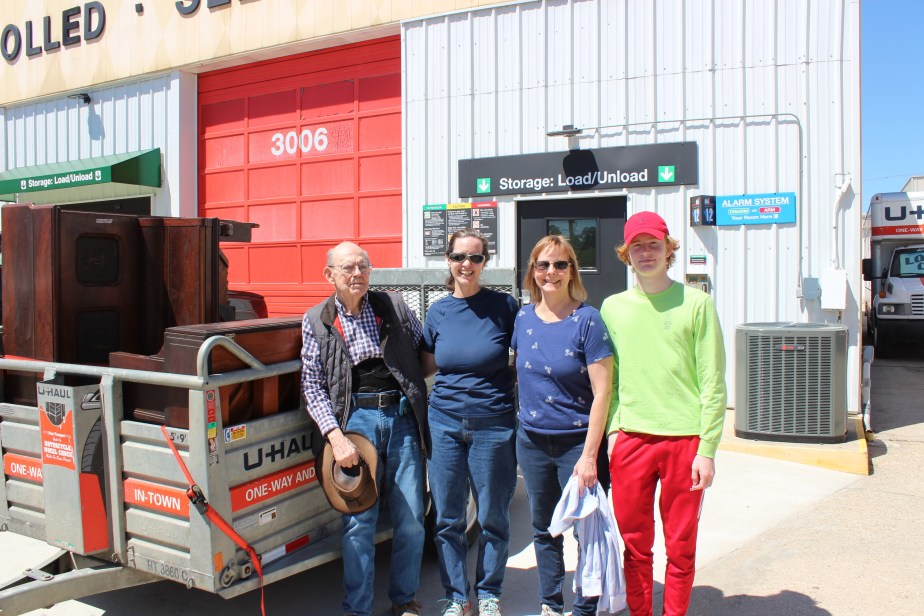
I recently made a few new connections in Slidell, Louisiana, when my two sons and I drove out there to meet a retired piano tuner, his daughter, and her son. We also brought back with us three old pianos and as many boxes of old piano action parts as we could fit in the truck without making one of my sons walk back home again! 🙂
This slideshow requires JavaScript.
What a joy it was to spend the day with these beautiful people! Our lives are forever changed by this happy connection.
Thanks again to Cee Neuner for her amazing directory, “For the Love of Challenges.” For the record, Cee’s directory lists not only photo challenges, but also writing and music challenges as well, and they are grouped by category. It’s very well organized.
For today’s curated post I am sharing a piano music video. In fact, I’m going to do that for the next three weeks. Why not? 🙂
‘I See the Light’ was composed for the movie Tangled, a Disney adaptation of the story of Rapunzel and their 50th animated feature film. The song was written by Alan Menken, who composed many songs […]
Do not disregard the Acrosonic piano as one of inferior quality, or a knock-off brand. According to Living Pianos, “Acrosonic is the biggest selling brand name in the piano industry of all time.” The name Acrosonic, coined from the Greek words akros (“supreme”) and sonus (“tone”), was trademarked and used by Baldwin specifically for their spinet and console pianos. Spinets and consoles are the shortest of the upright pianos, with the spinets measuring just 36-40 inches tall, and the consoles standing at 40-43 inches. This compact design was made possible by placing the action under the keys. Many people esteem the Acrosonic as the finest spinet piano ever built.
Spinet and console pianos are quite useful in small rooms, where an instrument is desired, but space is at a premium. The Acrosonic pianos by Baldwin were both compact and elegant, being offered in a variety of different cabinet styles and finishes, from Louis XV to Danish mid-century modern. They also were, and still remain quite affordable, being valued at between $1000–$3000, depending on their condition; and there are several currently available on eBay, with prices ranging from $0.99 to $3,800. I even found one within 200 miles from home, so that I could spare the shipping charges and go pick it up. The price was right, and the piano was very lovely. It was tempting. But it still works, so I could not justify purchasing it to take it apart and make art from it, and I already have a piano in my home to play. So I resisted the temptation and left it to go to another home.
D. H. Baldwin
Dwight Hamilton Baldwin was a respected music teacher and church musician in Cincinnati in 1857. Over the next eight years, he transitioned out of teaching and into a position as a purchasing agent for Chickering & Sons with his own company, Baldwin Piano Company. He had a stock of pianos, but lost all but one in a fire in 1866. By 1871, he had moved his firm to 142 W. 4th Street in Cincinnati, and he remained there until 1955.
With the help of Baldwin’s shrewd bookkeeper, Lucien Wulsin, Baldwin became the largest piano and organ dealer in the western states, eventually opening additional stores in Louisville, Kentucky, and Indianapolis, Indiana. For several years, his primary focus was retail, dealing with the resale of Chickering and Steinway pianos. But in 1887, when Steinway decided not to renew their contract with Baldwin, he shifted his focus to the production of his own line of pianos. While he did make pianos with the name Baldwin on them, he produced instruments under other names as well, often to honor people whom he knew. For instance, he built reed organs under the names Hamilton and Monarch; he also built upright pianos under the names of Ellington, Valley Gem, Howard, and of course, Acrosonic, among others.
Because of the superior quality of his pianos, Baldwin enjoyed the sponsorship of several celebrities, including Liberace and The Lawrence Welk Show, who used Baldwin pianos exclusively. Baldwin’s success lasted into the 1990’s. During that decade the company was sold to Gibson Guitar Company; and thanks to Gibson, Baldwin pianos are still being produced.
My Acrosonic
The Acrosonic that came to me came because I do taxes. One of my tax clients saw it on the curb in their neighborhood and sent me a text with the address. I drove over there and took all the parts that I could remove—which was most of them—then left the heaviest pieces for the sanitation engineers to collect. So I didn’t keep the entire piano out of the landfill this time, but there wasn’t much waste. Since it was sitting on the street, it was easy for me to lay the piano down to remove the pedals and other pieces underneath, then stand it back up again, a testimony to the lightweight nature of this model, that I could do all that by myself.
By tracing the serial number, 512480, I found the piano to have been built in 1954. On the cast iron plate, below the serial number, is a stamp that reads in part: “Patented Full Blow Acrosonic Action Built Exclusively by Baldwin.” The words “Built by Baldwin” are also imprinted in the iron plate, and they appear on the fallboard as well. The keys were not genuine ivory, as the use of ivory had been discontinued by the 1950’s, but they were in very good condition. The cabinet, however, could have been cared for a little better. There was a ring from where someone had set down a cold beverage glass, and several scratches and nicks in the finish. Overall, however, I was thrilled to come across this piano, and even happier that everything I took off of it (barely) fit inside my Nissan Maxima.
Today I would like to offer you a special treat: a video demonstration of what an Acrosonic sounds like. It really does have a nice sound, as I think you will agree.
Not only am I impressed with the sound of this tiny instrument, but I’m impressed with how similar in style this particular model looks to my piano. The color is different, but that is just a matter of a paint job. The dealer pointed out the purpose of the style was to mimic the square grand. When he said that, I looked at it again and thought, “He’s right.” It does resemble a square grand, though understated. It’s just one more example of how great things can come in small packages.
Bibliography
Pierce, W. Robert. Pierce Piano Atlas. 12th Edition. Larry E. Ashley Publishing: Albuquerque, NM, 2008
This week’s challenge comes from Lens-Artists Photo Challenge #43: Less Is More. I hope I’ve linked back to the correct blog. Anyway, I love what this photographer had to say on the subject. Allow me to share two quotes from her post, and I invite you to click over to her site to read the rest….
“A designer knows he has achieved perfection not when there is nothing left to add, but when there is nothing left to take away.” – Antoine de Saint-Exupery
“Simplicity is the ultimate sophistication.” – Leonardo da Vinci
Thanks again to Cee Neuner for her amazing directory, “For the Love of Challenges.” For the record, Cee’s directory lists not only photo challenges, but also writing and music challenges as well, and they are grouped by category. It’s very well organized.
I’m embarrassed, as a lover of classical music, not to have heard of the classical pianist Zhu Xiao-Mei, until very recently, coming by chance across her wonderful autobiography, The Secret Piano. Perhaps, given her history which is a history of her country in the latter half of the twentieth […]
Christmas was approaching, and we put our names in the hat for the gift exchange. I drew my brother-in-law’s name, but had no idea what to get for him. He is a cross-country truck driver, home only on the weekends. I’m an artist, specializing in things made from piano parts. I decided to make something for him from the materials at hand that he could carry with him in the truck.
First, I went to social media and downloaded a nice photo of my sister, and cropped it to 5×7. Then I went out to the garage, to my supply of piano wood, and taking the footboard from the 1915 Kohler & Campbell upright piano, cut two pieces from it, trimmed to approximately 6×8, and sanded the edges nice and smooth.
The veneer was loose on one side of the wood, so I removed it completely on that side, then stained the cut edges of the wood and the exposed wood where the veneer had been removed, and set it aside to dry while I worked on the photos.
The original photo I kept pretty much as it was, with the exception that I applied a sepia filter to it in Photoshop. Then I copied and reversed it on the vertical axis, forming a mirror image of the original. I then made the reversed image transparent (like a watermark) and added over the top of it the words, “Happiness is having someone to come home to.” I ordered the prints through Sam’s Club and picked them up an hour later.
Happiness
Back home, I used a spray adhesive to apply the photos to the inside panels of the wood, then let them sit several hours to dry. The next day I attached the two pieces of wood with two store-bought hinges and applied two coats of a clear polyurethane varnish to all surfaces, allowing time to dry between coats. Finally, I let it rest a few more days to cure.
When Christmas came, I was a bit apprehensive, wondering if Richard would like his gift. I didn’t need to worry—he loved it!
I can make one for you as well. Simply send me a photo and payment, and I will do the rest. The finished product may look slightly different from what you see in the photos here, depending on which piano gives you its wood, but the end result will be a unique and beautiful keepsake—made from the wood of an old piano—that you and your loved one will treasure for years to come.
This was an old piano before it came home. My son and I were just deciding how to extricate it from its place in the back of a garage. While he summed up the situation, I lifted the fallboard a bit to examine the keys.
A bunch of keys have been cleaned, cut, sanded, and are now ready to be painted, lettered, and made into Christmas ornaments.
Many small letter tiles have been cut from piano key extensions, sanded, painted, sanded again for a distressed look, and hand lettered. They will be added to a large Keyed Up, a set of piano keys used to store none other than keys!
This last photo is an action waiting to be removed, disassembled, cleaned, and put to use.
Thanks again to Cee Neuner for her amazing directory, “For the Love of Challenges.” For the record, Cee’s directory lists not only photo challenges, but also writing and music challenges as well, and they are grouped by category. It’s very well organized.
This article is geared toward music teachers, and it is jam-packed with excellent advice and a lot of links to other articles as well. It almost makes me want to offer piano lessons again so I can put these principles into practice myself. But since that is a bit impractical at this time in my life, I thought I would simply share them with you.
This article is inspired by two things: 1. A captivating TED talk that addresses the “checklisted child” and the TWO things they need most from their parents. 2,588 more words
The Behning Piano Company, established in 1861 in New York, survived for nearly 100 years, and has a colorful history. I’ve decided to show its history in a time line format, as the ownership/management underwent several changes over the years.
1861 ~ Henry Behning establishes Behning Piano Company in New York City on East 128th Street
1864 ~ Behning partners with Mr. Albrecht Klix, building pianos under the name of Behning & Klix
1873 ~ Behning terminates partnership with Klix and continues building pianos under his own name
c.1875 ~ Behning partners with Mr. Diehl
1878 ~ Behning terminates partnership with Mr. Diehl
1881 ~ Behning partners with son Henry, and name changes to Behning & Son
1920 ~ both sons, Henry and Gustave, take over the company and expand to East 133rd Street and Alexander; name changes to Behning & Sons
1931 ~ Gustave runs the company on his own and moves it to West 51st Street
When you think of old pianos, do you think of ornate carvings? The fancy pianos are the ones made in the early 1900s and before. Behning & Sons certainly made some of the finest, most ornate pianos I have ever seen, according to photos I’ve come across on the Internet. The Behning & Sons piano that was given to me was marked with Serial #48409, indicating that it was manufactured in 1922, when the two sons were running the company. I don’t recall much about what this piano looked like, except that it was plain. This one came into existence right on the heels of the Great Depression. People did not have money for extravagance. Their lives had been stripped of frills and “extras.” They had no use for ornate things; now they wanted more practical items in their homes. This is why piano makers, including Behning & Sons, started producing the plain, boxy style cabinets for their upright pianos. Shorter pianos also became more popular because they took up less visual space in the room, as rooms were smaller than before. Grands and baby grands were still being produced, and the styles of their cases were also simplified.
Quality Pianos
Piano manufacturers also learned how to make “economy” pianos so that people could still enjoy music on a tighter budget. Sometimes the result meant a sacrifice in quality, but often it was more a sacrifice in aesthetics, with still a pleasing sound from the instrument. Behning & Sons did not sacrifice quality. In fact, they were known for producing high-quality, expensive pianos, and enjoyed a great deal of success. They even made the Wendland player piano during the years between 1910 and 1930. Perhaps it was their self-imposed standard of high quality that made it hard for them to survive the Great Depression, for not too long after that period, the younger son, Gustave, being left alone with the company, was compelled to sell it to Kohler & Campbell, who kept the name alive for nearly another quarter of a century. (I thought this was interesting, since I’ve also come across a 1915 Kohler & Campbell piano.)
My photos of this piano are not impressive, but are mostly “for the record.” Usually I take the entire piano away when I acquire one, but this was one of the rare occasions when I got to disassemble it on-site and take only what I could carry. With the seats all folded down in the minivan (not the van in the photo), we were able to take everything but what was firmly attached to the cast iron plate. In other words, I did not keep the strings or the soundboard, nor the side boards or back boards, but I kept everything else. I got good photos of the markings on the plate because I knew I would never see it again, and those markings are how I identify the piano.
Also in the photos you will see the son of the dear folks who gave me the piano, my son who helps me with most of the moves, and our indispensable Dolly.
If you own a Behning & Sons piano, you can be proud of the fine-quality, American-made musical instrument that graces your home, and I hope you will care for it and play it often.
Bibliography
Pierce, W. Robert. Pierce Piano Atlas. 12th Edition. Larry E. Ashley Publishing: Albuquerque, NM, 2008
This week’s challenge is “Worship” hosted by Frank from Dutch Goes the Photo. My photos for this week’s challenge would not win any contests or strike awe in the viewer, but they do capture true worship in action, not the shadow of a place where worship once took place, however romantic that haunting scene may now appear.
You know, the funny thing is, I’ve been involved in church music for most of my life, but I’ve been hard pressed to find a photo of someone seated at the piano during an actual worship service. I have a growing collection of photos of church buildings, but almost no representatives of the worship that takes place on the inside, and particularly at the piano bench. I suppose that’s because it’s hard to take pictures while worshiping, and especially while playing. 🙂 But here’s one that someone else took and gave to me, taken from close to the back of the sanctuary. It’s rather small, I know, but this tiny frame holds some huge memories for yours truly.
Nearly 1,000 miles separate me from that congregation now, but as I look at the photo, I can hear the music coming from the baby grand piano, blending nicely with the crisp tones of Jimmy’s trumpet. As the song of praise draws to its dramatic conclusion, a chorus of amens echoes throughout the pews, then the pastor rises to the pulpit to continue the service with a message from God’s Word.
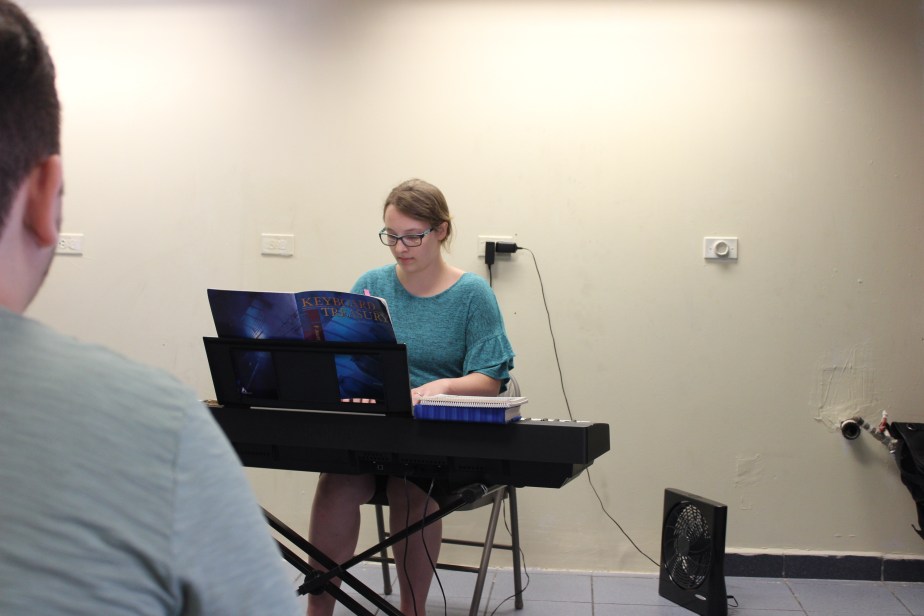
Below is another example of piano worship. This one was taken just last summer, when my daughter and I went to Mexico to visit some dear, sweet missionary friends, Tom and Jean Zartman, in Monterrey. Mary and I sang a duet, and she played a piano solo in the Sunday morning service, which meets in the lower floor of a dance studio. As you see, it’s not the building that matters, but the people. This church—this congregation—meets three times throughout the week, in three different places. But they are the same church. This serves to remind me that the church is not a building, but a body of believers who join together to worship the Lord Jesus Christ and sing His praises.
Where will you worship this coming Sunday?
Thanks again to Cee Neuner for her amazing directory, “For the Love of Challenges.” For the record, Cee’s directory lists not only photo challenges, but also writing and music challenges as well, and they are grouped by category. It’s very well organized.



 Encore! Old Pianos with a New Song