Weekly Photo Challenge: Connection

This week’s challenge comes from Little Pieces of Me, where for the month of May the theme of her Go on a Photo Adventure challenge is CONNECTION.

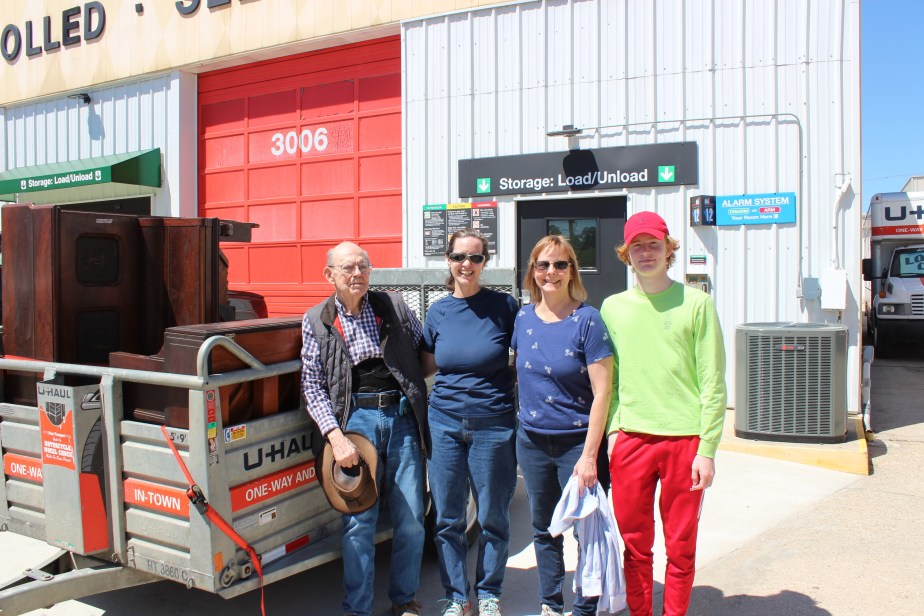
I recently made a few new connections in Slidell, Louisiana, when my two sons and I drove out there to meet a retired piano tuner, his daughter, and her son. We also brought back with us three old pianos and as many boxes of old piano action parts as we could fit in the truck without making one of my sons walk back home again! 🙂

Slidell Pianos (2)

This slideshow requires JavaScript.

What a joy it was to spend the day with these beautiful people! Our lives are forever changed by this happy connection.


Thanks again to Cee Neuner for her amazing directory, “For the Love of Challenges.” For the record, Cee’s directory lists not only photo challenges, but also writing and music challenges as well, and they are grouped by category. It’s very well organized.

Weekly Photo Challenge: Less Is More

This week’s challenge comes from Lens-Artists Photo Challenge #43: Less Is More. I hope I’ve linked back to the correct blog. Anyway, I love what this photographer had to say on the subject. Allow me to share two quotes from her post, and I invite you to click over to her site to read the rest….

“A designer knows he has achieved perfection not when there is nothing left to add, but when there is nothing left to take away.”
– Antoine de Saint-Exupery


Quartet (03)

“Simplicity is the ultimate sophistication.”   – Leonardo da Vinci


Thanks again to Cee Neuner for her amazing directory, “For the Love of Challenges.” For the record, Cee’s directory lists not only photo challenges, but also writing and music challenges as well, and they are grouped by category. It’s very well organized.

From the Studio: Coming Home to You


Christmas was approaching, and we put our names in the hat for the gift exchange. I drew my brother-in-law’s name, but had no idea what to get for him. He is a cross-country truck driver, home only on the weekends. I’m an artist, specializing in things made from piano parts. I decided to make something for him from the materials at hand that he could carry with him in the truck.

First, I went to social media and downloaded a nice photo of my sister, and cropped it to 5×7. Then I went out to the garage, to my supply of piano wood, and taking the footboard from the 1915 Kohler & Campbell upright piano, cut two pieces from it, trimmed to approximately 6×8, and sanded the edges nice and smooth.

The veneer was loose on one side of the wood, so I removed it completely on that side, then stained the cut edges of the wood and the exposed wood where the veneer had been removed, and set it aside to dry while I worked on the photos.

The original photo I kept pretty much as it was, with the exception that I applied a sepia filter to it in Photoshop. Then I copied and reversed it on the vertical axis, forming a mirror image of the original. I then made the reversed image transparent (like a watermark) and added over the top of it the words, “Happiness is having someone to come home to.” I ordered the prints through Sam’s Club and picked them up an hour later.

Back home, I used a spray adhesive to apply the photos to the inside panels of the wood, then let them sit several hours to dry. The next day I attached the two pieces of wood with two store-bought hinges and applied two coats of a clear polyurethane varnish to all surfaces, allowing time to dry between coats. Finally, I let it rest a few more days to cure.

When Christmas came, I was a bit apprehensive, wondering if Richard would like his gift. I didn’t need to worry—he loved it!

I can make one for you as well. Simply send me a photo and payment, and I will do the rest. The finished product may look slightly different from what you see in the photos here, depending on which piano gives you its wood, but the end result will be a unique and beautiful keepsake—made from the wood of an old piano—that you and your loved one will treasure for years to come.

Happiness is coming home to you!

From the Studio: Piano Headboard

headboard made from an old pianoIt’s always exciting when someone asks for a custom order. Such was the case with the headboard. I had made a mirrored coat rack from the music shelf of the Lyon & Healy piano and took it with me to a craft fair. A lady saw it, and it gave her an idea for something special she could do for her mother, who was a retired piano teacher. Her mother lived with her in her home, and she slept in a hospital bed to aid in her comfort. But the bed did not have a headboard. So the lady visiting my craft fair booth wondered if I could make a headboard from a piano music shelf. I told her I would try.

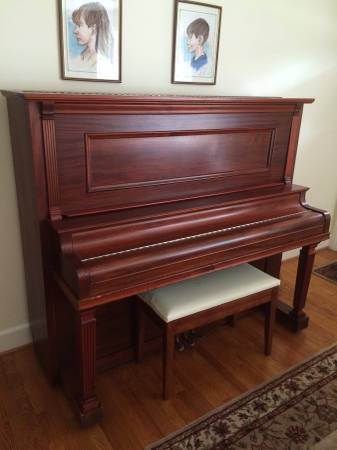
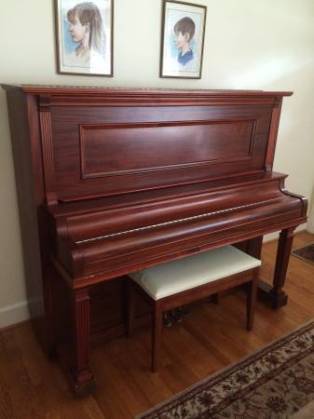
At home I looked at the other pieces I had from other pianos. Most of them were in poor condition, and I was inexperienced at that sort of restoration. So I began to shop around, mostly looking at the local listings on Craigslist. Pretty soon I found a piano near me at a price that I could afford, and I purchased it. So it was that I came across this beautiful Royal Cabinet Grand. Incidentally, this is also when I learned that the tallest of the upriRoyal Cabinet Grand (1)ght pianos are actually grand pianos built vertically—hence the term “upright grand.” I call this one a cabinet grand because that is the name so designated on the piano.

My sons helped me get it home, and I went to work right away to build the headboard.

The first question to determine was how long the headboard should be. It was going to be longer than the bed was wide, no question about it. I removed the music shelf and the side pedestals from the piano, laid them out on the floor of my studio, then took pictures of them to send to my customer to show her what I had found. I also wanted her opinion as to whether to include the pedestals as part of the headboard. They would add visual interest, but they would also add width to an already too-wide headboard. She liked the look, however, so the pedestals stayed.

piano music shelf to become a headboard

As with the coat rack I had built from the other piano, I flipped the music shelf upside down so the actual shelf would be up top.

On the piano, the music shelf had been hinged near the center, and the pedestal had been attached to the cabinet. In order to attach the pedestals to the shelf, I used key extensions on the back, which were secured with screws (from the piano action) and wood glue.

The headboard was not going to be attached to the bed, but was only going to lean against the wall behind it. Since the headboard had a gorgeous red mahogany finish, I went to the local hardware store to purchase a length of mahogany 2×4 wood to make the legs. They would be hidden by the bed, but just the same, I wanted them to suit the headboard. With a coat of stain for the legs and the key extensions on the back, everything was beginning to look quite nice. I attached the legs with antiqued brackets, and moved on to the finishing touches.

The next step was to conceal all the minor scratches and flaws. Then taking some green felt that I had removed from the piano and cleaned, I applied it to the places where the headboard would rest against the wall, to prevent any marks on the same. We bought a set of sliders to go under the legs, and the headboard was finished and ready for delivery.

This slideshow requires JavaScript.

It was a happy day when I got to meet the lady who would enjoy this piano headboard. I put it in her room, and listened with delight to some of her stories of her glory days as a pianist and teacher. My friends, that’s what piano art is all about.

A Brief Reign for the Royal Piano Company


The Royal Piano Company did not exist a long time, and information regarding their organization and operation is hard to find. But in their short span on the industrial scene, they produced some of the finest musical instruments America has ever seen. Royal was established around 1895 and manufactured fine quality pianos for about half a century, producing a full line of uprights, player pianos, and baby grands. They also built pump organs in the early years of the company’s existence.

Royal was originally a division of the Krell Piano Company, and it was bought out by Werner Industries of Cincinnati shortly before 1920. The Starr Piano Company purchased the Royal brand in 1927, and thus kept the Royal name alive during the Great Depression.

The last Royal piano was built in 1949. Today they are rare, but if you happen upon one, you will find it to be an example of quality workmanship.

The One I Acquired

Royal Cabinet Grand (1)

The Royal Cabinet Grand that came into my possession was not a gift, but was actually the only piano to date for which I have put down money (apart from moving expenses). I had been commissioned to make a headboard for a retired piano teacher who was confined to a hospital bed in her room. The former teacher’s daughter saw a coat rack that I had made from the music shelf of the Lyon & Healy, and she thought a headboard would be perfect for her mother, who had devoted her life to teaching others how to play the piano. How could I say no? I had several large pieces at hand, but none worthy of such an assignment. So I searched eBay, Craigslist, and other local listings until I found the perfect piano. It wasn’t free, but it was affordable.

Since I purchased the piano with a particular project in mind—the headboard, the majority of my photos of this piano are focused on the music shelf. Evidently, I didn’t even think to take a photo of the serial number, which is something I ordinarily do with every piano. Or if I did, I didn’t file the photo correctly. Unfortunately, that number is long gone by now, so I’ll never be able to determine exactly when this piano was made.

But there is a silver lining, for maybe someday, in a bin in the garage, I’ll find the cast iron plate that bears the Royal name. For I noticed in one of the photos that I removed the plate before letting Bobby haul the frame to the scrap yard. And in my search for information about the Royal Piano Company, I found a similar plate on a estate sale website that sold for over $200. Wouldn’t that be nice…. ☺

It has been noted that Royal pianos are known for their fine craftsmanship. I can definitely attest to this. At this point, I don’t remember which hammers, whippens, or stickers in my bins came out of the Royal Cabinet Grand, but I do remember the wood case, that it was both beautiful and solid. When we were preparing to move, some of my pieces got rained on, and I was horrified to learn (when the pieces swelled) that two of the pianos were partially built with press board! I was shocked! Most of them were not, however, and the Royal is most certainly made of solid wood. I don’t know for sure what kind of wood it is, but it is a hardwood. My saw and drill can attest to that (and my tired arm). Yet the most impressive thing to me—especially after taking apart thirteen pianos thus far—is not the fact that the cabinet is solid, or that it is made of hardwood, but the thickness of the wood, especially on the sides of the cabinet. On every piano, the side arm (the part that often resembles a grand piano in its shape) is nearly two inches thick, but the side board (the board that covers the length of the piano) is usually less than one inch thick, though it may have some trim along the edge to give the appearance of extra thickness. On the Royal Cabinet Grand, the entire side board was as thick as the side arm—just under two inches. And the cabinet’s finish was a gorgeous red mahogany.


The wood of the side board was too thick to use in large pieces, but too nice not to use at all. So I cut the wood into blocks measuring 6″ x 7.5″ and made game boards out of them, using tuning pins as the playing pieces. The concept was fairly easy to devise, but the implementation turned out to be difficult with hand tools. I made five games last year. They were imperfect at best, but my husband was impressed enough to purchase a drill press and power sander for me so that my next batch of board games will come out a lot nicer. Isn’t he sweet! Royal Cabinet Grand (1)

Of the thirteen pianos I’ve disassembled so far, the Royal Cabinet Grand is the only one to give me good quality wood that I can use to make these board games. Hopefully I’ll come across more pianos built with this level of quality in the near future.

If you happen to have a Royal piano, by all means keep it and treasure it. Tune it. Play it. Enjoy it. Pass it down to your children and their children after them. Don’t let it go the Piano Lady to be cut up and made into headboards, games, and art—not unless it absolutely must be thrown away. In that case, do call me first (if you live within 200 miles of Pensacola, FL). But please know that I no longer purchase pianos. I will, however, thank you for your donation by making you a souvenir piece of art from your piano.


Bibliography

Pierce, W. Robert. Pierce Piano Atlas. 12th Edition. Larry E. Ashley Publishing: Albuquerque, NM, 2008

antiquepianoshop.com

coolpianostuff.com

sweeneypiano.com

The Premier Estate Sale Marketplace


From the Studio: Bach Yard Chickens

Raising backyard chickens has really taken wing in the US. Sorry. Was that a bad pun? Okay. I’ll stick to piano art and leave the comedy for the comedians. 😉

But I wasn’t trying to jump on the bandwagon when I created “Bach Yard Chickens.” I simply saw the hammer butts and thought they looked like chickens. Period. End of story. The little girl, as hard as she was for me to paint, seemed a little easier than painting a barn. Not only that, but for each of my creations, I try to come up with a music-themed title. So… “Bach Yard Chickens” or “Old MacDonald”? Which one would you have chosen? I thought so. Me too!

Bach-Yard Chickens 10
Bach Yard Chickens (2015)

The painting above was my first ever “Bach Yard Chickens,” completed in 2015. It was done on a 16×20 stretched canvas, unframed. I used uncooked quinoa for the “seed,” and all five “chickens” came from the same piano. In fact, they came from the 1906 Lyon & Healy, my first piano. (At the time, it was my only piano.)

Spreading My Wings

I had been really nervous about creating this particular piece because I had never painted a person before. I was working off a photograph, and the girl didn’t turn out exactly like the image in the photo. But I figured it was okay; she was good enough. And I guess she was, for this painting was the first item to sell in the craft fair that year, which was very encouraging to me. In fact, it sold within fifteen minutes of the show’s opening.

So why did it take me another four years to work up enough courage to make Bach Yard Chickens #2? I honestly couldn’t tell you. But the second one is done, and it’s pictured here.

acrylic painting of girl feeding chickens
Bach Yard Chickens (2019)

This one has some obvious differences. One variation you may not notice in the photos is the size, for this one is an 11×14. I decided to try a smaller size because the piano parts themselves are so small by comparison to the canvas. I also have two more 11×14 paintings nearly finished. However, I do prefer the larger size, and will make the future paintings in the original 16×20 format.

Another difference is that the “chickens” now come from different upright pianos, to represent the reality that in a brood of backyard chickens, they will not all look exactly alike.

The Process

Hammer Key Chains (20)
Various hammers from upright pianos

Here are some representatives of the hammers I’ve taken off the pianos. When I remove them, they are dirty. I have to scrub them clean with a wire brush, then separate the various parts. Each individual piece has a name, but for the sake of simplicity, I’ll call the entire “chicken” part the hammer butt. It has a flange attached at the chicken’s “eye,” made of either wood or metal. I have a special tool that helps me to quickly and safely remove the flange, which I save for later use in another project.

You may also notice a string coming off some of the chickens. That’s called the bridle strap. Sometimes I can pull it off, but other times I have to cut it off with a box cutter.

For the next step, I take the hammer to the garage, where my power tools are set up. One of my table saws is equipped with jig saw blades. I use this one to remove the hammer shank (long stick) from the hammer (where the felt is) and hammer butt (a.k.a. chicken). The hammer shank goes into a storage container for some future use which I haven’t figured out yet. The hammer is set aside to be used as a key chain or as a head for a Conductor or Instrumentalist.

Finally, with a little sanding, the butt is ready to be used as a chicken. This process takes about 45 minutes to an hour for 5 chickens, not counting the time it takes to remove the hammer from the piano. That stage can vary greatly, I’ve come to learn, depending on the manufacture of the piano. The new flange removal tool has shortened the time by a good 15 minutes. Before I got that tool, I used any sharp tool I could find, such as an ice pick, to push the pin partway through, then I would pull out the rest of the way with pliers. This was tedious and made my hands hurt after a while. I’m very thankful for the new tool!

Art for Arts’ Sake

One of my favorite things about Bach Yard Chickens is getting to paint the background. I love what I do with old pianos, but above all, I love that God gave me the ability to paint. I don’t have much training in that area, but I do long to develop what talent is there by practicing. I want my work to be more than a craft—I want it to be an art.

Thank you for joining me on this tour of the studio. I look forward to seeing you on the next one. Until then, I invite you to check out photos of my other work in the gallery. Enjoy the rest of your day!

Kohler & Campbell: King of the Industry

Hughes 01

A Perfect Match

Charles Kohler was only twenty years old in 1894, when he and John Calvin Campbell united forces to establish Kohler & Campbell Industries, Inc., in New York City. Though a young man, Kohler was considered a genius as a businessman and factory superintendent. His partner, J. C. Campbell, was a machinist skilled in working with both wood and iron, and he used these skills to improve the manufacturing of pianos and earn Kohler & Campbell their reputation for offering “the best value for the dollar.” These two men were a perfect match in business, and their company grew to become one of the all-time giants in the piano manufacturing industry.

Bought and Sold

Campbell died unexpectedly in 1908, and Charles Kohler took control of the company. The business continued to expand, as they absorbed less successful names, such as Autopiano (ca. 1920), Waldorf (mid-1920s), Behning (1926), and Newton (ca. 1930). During the pre-Depression era, the Standard Pneumatic Action Company, a subsidiary of Kohler & Campbell, manufactured an impressive 50,000 player piano actions, and more, per year. Kohler & Campbell grands were made by Brambach in Granite Falls, NC, and in 1954, all production was moved to Granite Falls.

For 100 years the company thrived in the United States as a supplier to major retailers across the country. However, they hit hard times in 1985 and suspended manufacturing. After negotiations, Sherman Clay bought the Kohler & Campbell name and contracted Samick USA to build Kohler grand pianos for retail stores. Later, Samick USA bought the name from Sherman Clay and expanded distribution to South Korea.

Kohler pianos are still being produced today, and the line has now been expanded to include digital pianos in both baby grand and upright cabinet styles. Once the king of the industry, Kohler is still a major presence. If you own a Kohler piano, or a Kohler & Campbell, you may be proud of its amazing history.

The One I Acquired

The Kohler & Campbell piano that was given to me was an upright grand, serial number 163634, which dates to 1902, meaning this piano was built when the company was only eight years old, and it was 113 years old when it joined the Encore! family. Unfortunately, it suffered much water damage while in storage, but I was able to use the keys and the action. I still have many pieces of the case, but have not tried to restore them. Soon I will.

A friend and fellow choir member gave me the piano, so I thought it would be appropriate to use pieces from this piano to make Christmas gifts for the choir members. And that’s exactly what I did. The choir director got a Conductor made of whippen and sticker assemblies (technically not from this piano), and each choir member received an ornament for their Christmas tree. They were able to choose from a hammer ornament or a diamond-shaped ornament cut from the soundboard. This piano had a most unusual action piece that I had never seen anywhere else. It was shaped like a bell (see photos), and I used it to decorate a second set of soundboard ornaments which we gave to the members of my daughter’s handbell choir.

All the ornaments were personalized on the back with the year and the name of the choir. I still love pulling mine out each year and hanging it on the tree, even though we’ve since moved to another state and sing in another choir. When I look at that ornament, I’m reminded of the friends whose voices used to blend with mine in praise to God. I see their faces, and I smile. That, my friends, is why I make art from these old pianos.

This slideshow requires JavaScript.


Bibliography

Pierce, W. Robert. Pierce Piano Atlas. 12th Edition. Larry E. Ashley Publishing: Albuquerque, NM, 2008

antiquepianoshop.com

kohleryandcampbell.com

kohlerdigitalpianos.com


Lyon & Healy Didn’t Just Make Pianos

Lyon & Healy upright grand piano

The piano that started me on my art journey was a Lyon & Healy upright grand, built in 1906. In addition to studying the parts themselves to figure out what I could do with them, I also wanted to learn all I could about who made this fine musical instrument. While I do not claim to know enough to even call myself an amateur, I will gladly share with you the snippets I have learned.

George W. Lyon and Patrick J. Healy came from Boston to Chicago in 1864 to open a store selling sheet music. Their venture proved to be extremely successful, and within a year they expanded the business and began carrying musical instruments as well. They survived the Great Fire of 1871 because they had excellent insurance coverage. While rebuilding, they acquired the piano business of another firm and became the sole representative in the Chicago area of Steinway & Sons. This was the start of a meaningful relationship with the piano icons from Germany.

Harping on Excellence

Healy noticed that his repair shops were filled with harps that needed a great deal of work, so he set about to design “the finest harp the world has ever seen.” It took years of research, but in 1889, the first Lyon & Healy harp was produced, and it was played daily at Morgan Park High School in Chicago for 90 years, until it was returned to the company to be put on display in the Museo Dell’Arpa Victor Salvi in Italy. Healy’s hard work paid off, and his company became known as the world’s leading manufacturer for concert harps.

In the late 1800s Lyon and Healy further expanded their business. They were already carrying pianos made by other manufacturers, but now they began to produce their own: uprights, players, and grands. They also produced a line of upright pianos under the name of “Washburn” as an affordable alternative to the more elite Lyon & Healy brand.

Pianos and harps were not the only instruments produced by Lyon & Healy. For a while they also built pipe organs for both home and church use, as well as a variety of brass and woodwind instruments. And they did not forget their humble beginnings, for by 1930 they were the largest distributor of sheet music. In fact, they were advertised as being “the world’s largest music house.” New upright pianos sold at that time for $125 to $290. Bear in mind that the average house sold for $4,700, you could buy a car for $1,450, and a loaf of bread cost 4 cents. Many professionals had an annual salary of $1,500 to $4,000.

The Great Pruning

During the Great Depression, the Everett Piano Company bought Lyon & Healy’s piano division, but they continued making pianos under the Lyon & Healy brand until the 1970s, when Steinway & Sons purchased all rights to the name. Steinway closed all Lyon & Healy retail stores and discontinued production of all instruments and sheet music so that the company could focus on the production of harps. It sounds harsh, but sometimes a farmer has to prune branches that are producing fruit so that the remaining branches will produce more and better fruit. After this pruning, Lyon & Healy regained their focus, and their harp industry continues to this day. If not for the hard decision that Steinway made back in the 1970s, Lyon & Healy may well have closed their doors completely by now.

After reading about the humble beginnings, the amazing accomplishments, the harsh pruning, and the incredible longevity of this great company, I have even more respect for the makers of the fine instrument that started me down the path of creating piano art.

Does It Hurt?

At craft shows I have the pleasure of meeting and conversing with a good many folk who stop by my table. Often they ask, “Does it hurt you to take the pianos apart?” My answer has always been: “No. It’s my pleasure because I am keeping them out of the landfill; I’m giving them a new purpose.” But today, after researching to write this article, I must admit that my heart is pained some—okay, more than a little—for this piano in particular. If I had known its history before we started to take it apart, I would have found the $5,000, or whatever it would have taken, to restore it. Because this one would have been worth the cost. And yes, I’m writing this through tears. It’s just a bunch of wood and metal, you say. But that hunk of wood and metal was assembled by a master craftsman, better than most of the others I’ve come across. I can only hope that the people who have purchased items made from the gorgeous tiger oak cabinet and all the action pieces within will appreciate the love that went into creating the piano in the first place, and then the love that went into creating the art.

Here are a few photos of my 1906 Lyon & Healy, as well as some of the works of art I made from it:

This slideshow requires JavaScript.


Bibliography

Pierce, W. Robert. Pierce Piano Atlas. 12th Edition. Larry E. Ashley Publishing: Albuquerque, NM, 2008

antiquepianoshop.com

lyonhealy.com

answers.com


Riverwalk Arts Festival Update

I promised you an update on the arts festival from this past weekend. In a word, it was tremendous! My daughter and I picked up my packet Friday afternoon, and we set up the tent and tables that evening. Due to the inclement weather, and the sensitivity of the piano parts to humidity (especially the felt), I decided not to set out my merchandise until Saturday morning. We also helped one of our neighbors with her tent, as it was similar to ours and new to her. One of the joys of doing shows is getting to meet the neighbors.
My daughter had things to do on campus, so I took her back Friday night and went alone to the festival early Saturday morning to set up. I had made a good call, for it rained during the night. Nothing was wet except the ground, and everything was off the ground. So I pushed the puddled water off the roof of my tent, opened up the walls, and got everything in its place just in time, about fifteen minutes before time for judging.
When the judge came by, she blended herself in with the crowd, and I never knew she was there. So when she and another lady stopped by my table in the early afternoon with a blue ribbon, I was completely astounded and elated. This was my first juried event, so needless to say, I was on Cloud Nine.
I had been wondering whether or not to stay for Sunday. The Lord held off the rain for most of Saturday, with the exception of just a light sprinkle, but Sunday we were expecting a downpour. Not only that, but my family would be in church and unavailable to help me take things down. So I prayed for a particular amount in sales on Saturday as a guide to whether I should return, and the Lord gave me those sales. My husband came after work Saturday and helped me break down my tent. I had been busy helping my neighbor break hers down, so I wasn’t ready when he got there, but he was very patient with me. We went out to eat afterwards, rejoicing in the Lord and in the good day.
As it turns out, the storm did not come until after 2 p.m. Sunday, but it’s just as well that we packed up when we did. I attended the awards breakfast Sunday morning and got to meet our mayor and a few more fellow artists, including another artist who has some of her work in a gift shop in Navarre, the Sand Dollar Cottage. I’ve seen her work there and admired it, so it was a pleasure to meet her. At the breakfast, the spokeswoman said that in 31 years of hosting the Riverwalk Arts Festival, this is only the second time they’ve had rain. That’s a pretty good track record. Will I be back next year? You bet!



Weekly Photo Challenge: Dogs of Blogs


Riverwalk 2019
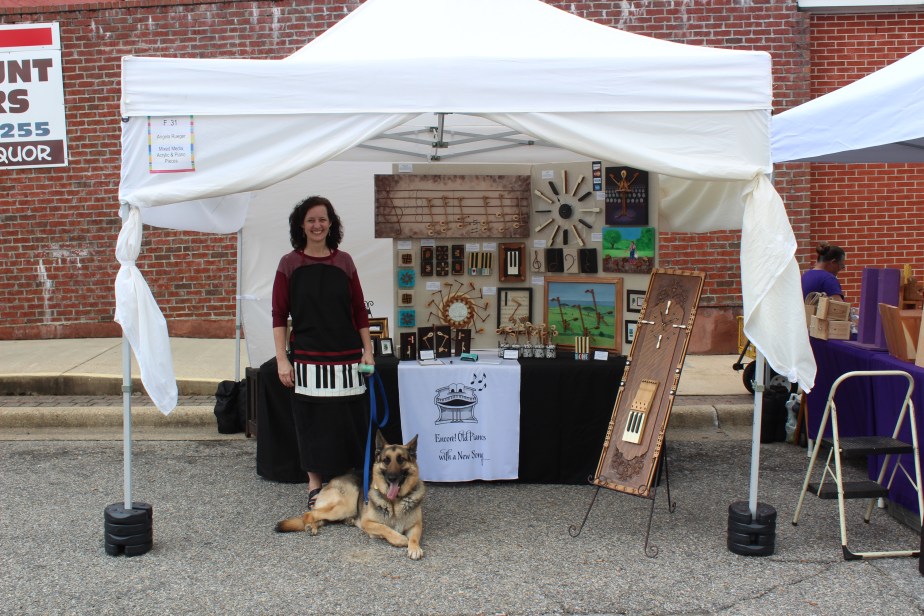
Guess who came to visit me at the show?

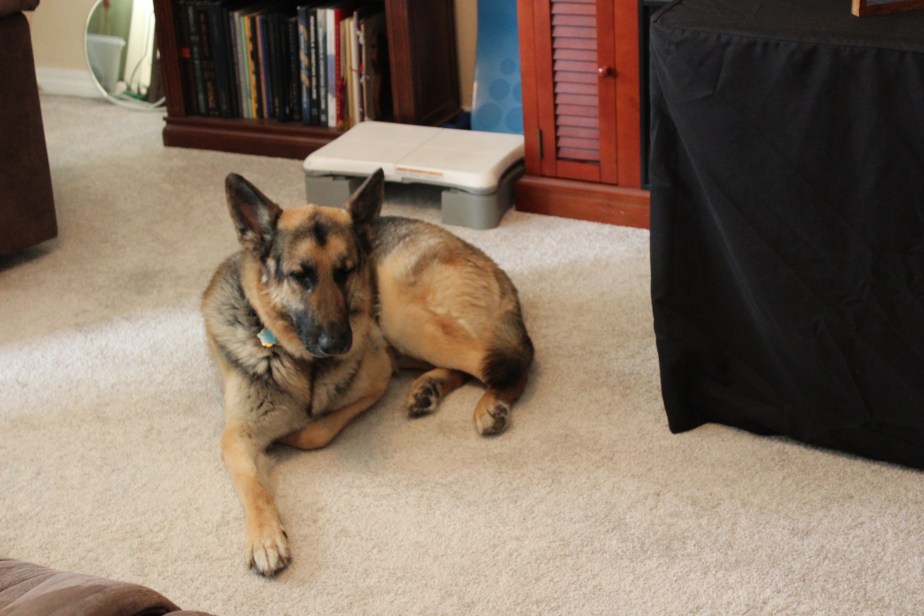
Duke, a 6-year-old German shepherd, is a relatively new addition to our family. My son adopted him a year ago in Virginia, and he just came to live with us last month. When Bobby found him, Duke was malnourished, sick, and severely underweight. With the help of a family friend, who also happens to be a veterinarian assistant, Duke got the care he needed, and now he is healthy and happy.

Duke loves to shadow me around the house. I don’t allow him in the studio because there isn’t enough room in there for the two of us, but he is right by my side in the living room and kitchen.

Duke did not go with me to the art show, but Bobby stopped by for a visit, and I asked him to take a photo of my display, with me in it. Naturally, I had to hold Duke so Bobby could hold the camera.

Getting ready (4)
Isn’t he a handsome fella?

This week I am responding to the photo challenge, Dogs of Blogs, hosted by Jessica of Sorting Life’s Issues with Jess. She has chosen a dog theme for the month of March to celebrate the birthday of her dog Oreo. I do hope you’ll hop over to her page and take a look. Her photos are absolutely adorable.

I discovered Jessica, her blog, and her challenge, on Cee Neuner’s list of challenges, so I wish to give her credit as well. Thanks, Cee, for this wonderful directory you’ve created: “For the Love of Challenges.” For the record, Cee’s directory lists not only photo challenges, but also writing and music challenges as well, and they are grouped by category. It’s very well organized.

Getting ready (1)
Duke waited for some attention while I worked on preparing my display.

Tomorrow I’ll give you more details about the show.


From the Studio: Quartet

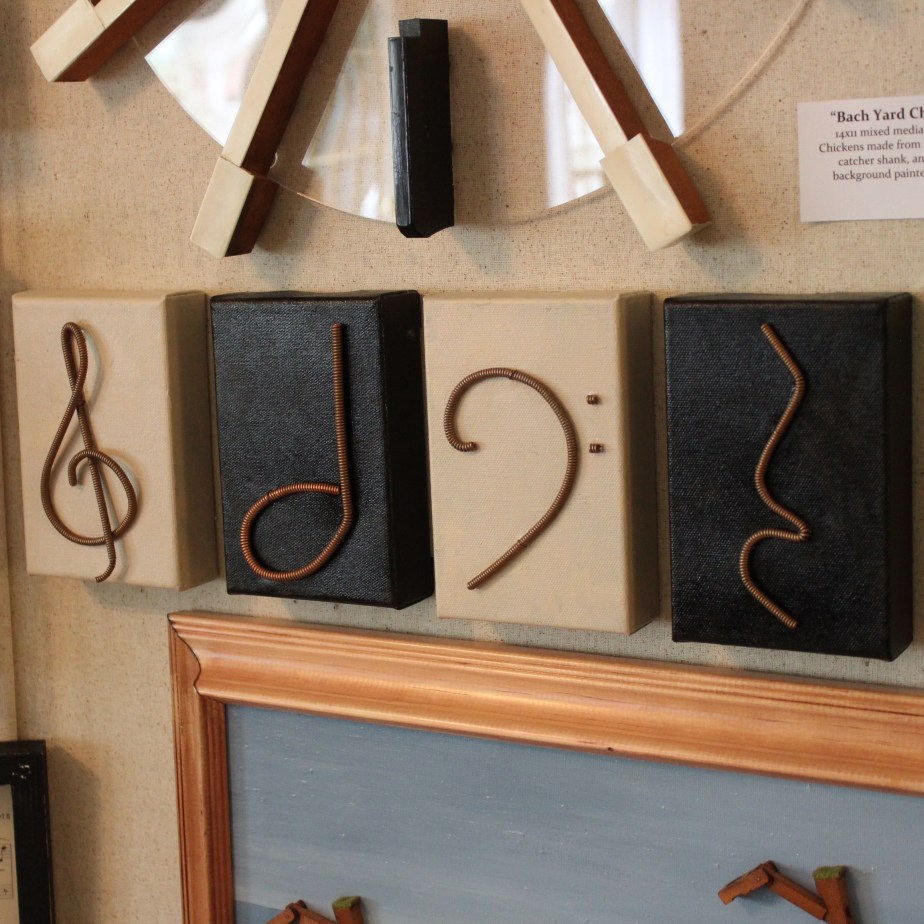
Strings. Every piano has them. I’ve been learning a lot about strings lately, because I’ve been cleaning them for a new project, and I came across an anomaly that prompted a bit of research. But that story is for a different day. Today I simply want to tell you about one of the many things I make with piano strings: the Quartet.

IMG_1188

The bass strings would have to be extremely long (like 30 feet!) to achieve the necessary pitch if they were not wound by copper to make them dense. Copper is a beautiful precious metal, and soft, but the steel core inside the piano strings is strong is difficult to bend into shapes. I have found shaping piano wire to be more challenging than the wire sculpting I tried in art class, but I do love a challenge!

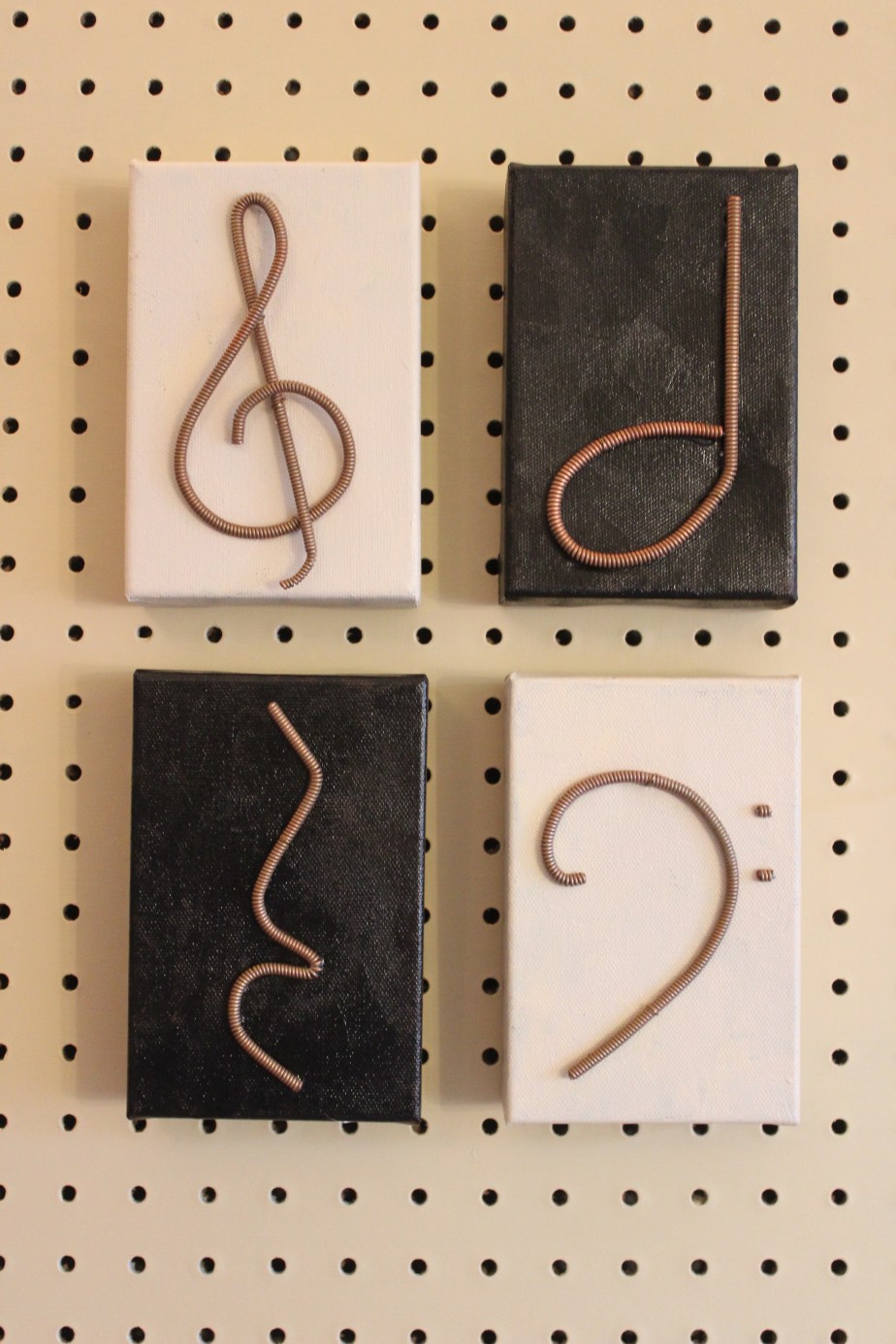
Just how this particular project came to be escapes me now. Why did I choose four musical symbols rather than two or three? I think it’s because I purchased a set of four canvases and then needed to do something with them, but who knows?

Why did I choose these four symbols? Okay, I know the answer to that question. Of all the possibilities, I chose the treble clef, bass clef, half note, and eighth rest because they are both easily recognizable and artistic to reproduce. The eighth rest has proven to be the most challenging of them all, due to its sharp angles and opposing curves, but there is great satisfaction when it finally comes out right.

I can create an entire set of symbols from one piano string. First I clean the string, then wearing gloves (to prevent tarnishing from the oils in my hands), I begin my work. My tools for the first part of the project include a metal file (to smooth the cut edges), bolt cutters (because wire cutters just don’t cut it), needle-nose pliers, and slip-joint pliers.

Quartet WIP (3)

To form the soft bends, I use my bare hands; but when the curve needs to come in sharply, that’s where the two pairs of pliers come in handy. They do tend to bend the wire unevenly, however, so I go back with my hands and smooth out the finish. Arthritis is starting to set it, and I feel it after several hours of working with wire. But I’m not going to stop. Would you?

I work with the entire length of wire because I have no idea how long each piece needs to be. Perhaps I should cut off a length and experiment with it, but I’ve never done that. So instead, I simply work until I’m satisfied, then cut off the excess, sand the cut edges, and move on to the next piece.

The colors for the canvases have varied greatly over the years, as I experiment with one look after another. But just this week, while getting ready for the Riverwalk Arts Festival, I was looking at the yet unfinished canvases as they hung on the display below the clock made of piano keys. The canvases had been dark brown and teal (two of each color). I had determined that the dark brown was not to my liking, so I changed it to a cream color—dark titanium white, to be specific. As I sat there looking at the display, I noticed that the dark titanium white looked very similar to the aged white of the keys on the clock, and I wondered if maybe the other two canvases should be a brown-black to match the ebony keys. Since the piano string shapes had not yet been mounted, it was easy to repaint the canvases. So I took them down and went back into the studio. First they got a coat of burnt umber, then while the brown was still wet, I marbled black all over. At a distance they appear black, but up close, you can see the marbling. I did this because genuine ebony keys are not pure black either, but up close you can see the ebony wood grain. This is not my usual marbling technique, but it’s what I wanted to do for these particular canvases, because I didn’t want too much brown, I just wanted it to take the edge off the black.


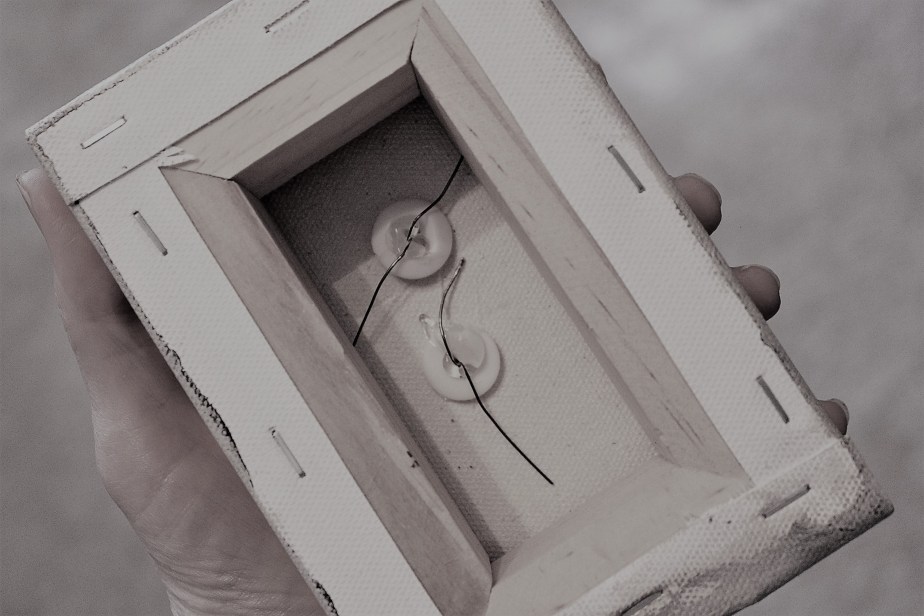
The canvases sat overnight to dry, and then I went to work mounting the musical symbols to the surfaces. First I tried using regular hot glue, but they popped right back off again. Forget that. Then I switched to an industrial strength adhesive called E6000. I’m sorry, I don’t know what else to call it. This stuff works really well in a variety of situations. Even so, I don’t put all my eggs in the E6000 basket. As an extra measure of precaution, I “sew” each musical symbol onto the canvas, to be sure it won’t come off. Using an ice pick, or similar tool, I carefully poke a hole in the canvas in two strategic places under the piano wire, where it won’t be noticed. Then I take a 3″ length of copper wire that I’ve unwound from a smaller (treble) piano string, form a loop, and push both ends through the hole in the canvas, looping the “thread” around the wire décor and effectively fastening it onto the canvas. On the back side of the canvas, I put a dab of hot glue, thread a button onto the wire, and press it down into the hot glue, then twist the wire to hold it firmly in place, and it’s done.

Quartet WIP (1)

Finally, I put the finishing touches on the backs of the canvases. First, I enclose them all with brown paper, then install a sawtooth hanger. Using some of the brown paper, I construct a small pocket and mount it to the back of one of the four frames. This will hold the sheet that tells the story of my piano art.

When the artwork is done, it needs a name. I have tried to give every piece of mine a name related to the field of music, for obvious reasons. 🙂 I have three different pieces that are sets of four, so naming them has gotten tricky. One of them is named “Harmony” because the pieces work together to form a cohesive whole. The second is called “Quatrain” because it has two sets of nearly identical pieces, so I think of it in terms of poetry (abba). That makes it easy to give this one the name “Quartet,” since this one is four different musical symbols that come together in one song.

And now this song is done.

Thank you for joining me on this tour of the studio. I look forward to seeing you on the next one. Until then, I invite you to check out photos of my other work in the gallery. Enjoy the rest of your day!


Music in Art on Display!

Tomorrow kicks off my very first juried art show! Here are a few photos of my display as it looked before I packed everything up, including close-ups of all the brand new items.

Setup is tomorrow, and the show runs all day Saturday and Sunday. Next week I’ll tell you all about it!