Why kids don’t practice and what to do about it — 88 Piano Keys

https://embed.ted.com/talks/lang/en/julie_lythcott_haims_how_to_raise_successful_kids_without_over_parenting

This article is geared toward music teachers, and it is jam-packed with excellent advice and a lot of links to other articles as well. It almost makes me want to offer piano lessons again so I can put these principles into practice myself. But since that is a bit impractical at this time in my life, I thought I would simply share them with you.

This article is inspired by two things: 1. A captivating TED talk that addresses the “checklisted child” and the TWO things they need most from their parents. 2,588 more words

via Why kids don’t practice and what to do about it — 88 Piano Keys

Behning & Sons Piano Company

The Behning Piano Company, established in 1861 in New York, survived for nearly 100 years, and has a colorful history. I’ve decided to show its history in a time line format, as the ownership/management underwent several changes over the years.

  • 1861 ~ Henry Behning establishes Behning Piano Company in New York City on East 128th Street
  • 1864 ~ Behning partners with Mr. Albrecht Klix, building pianos under the name of Behning & Klix
  • 1873 ~ Behning terminates partnership with Klix and continues building pianos under his own name
  • c.1875 ~ Behning partners with Mr. Diehl
  • 1878 ~ Behning terminates partnership with Mr. Diehl
  • 1881 ~ Behning partners with son Henry, and name changes to Behning & Son
  • 1920 ~ both sons, Henry and Gustave, take over the company and expand to East 133rd Street and Alexander; name changes to Behning & Sons
  • 1931 ~ Gustave runs the company on his own and moves it to West 51st Street
  • 1932 ~ Kohler & Campbell acquire the company
  • 1956 ~ production under Kohler & Campbell ceases

Pianos and The Great Depression

When you think of old pianos, do you think of ornate carvings? The fancy pianos are the ones made in the early 1900s and before. Behning & Sons certainly made some of the finest, most ornate pianos I have ever seen, according to photos I’ve come across on the Internet. The Behning & Sons piano that was given to me was marked with Serial #48409, indicating that it was manufactured in 1922, when the two sons were running the company. I don’t recall much about what this piano looked like, except that it was plain. This one came into existence right on the heels of the Great Depression. People did not have money for extravagance. Their lives had been stripped of frills and “extras.” They had no use for ornate things; now they wanted more practical items in their homes. This is why piano makers, including Behning & Sons, started producing the plain, boxy style cabinets for their upright pianos. Shorter pianos also became more popular because they took up less visual space in the room, as rooms were smaller than before. Grands and baby grands were still being produced, and the styles of their cases were also simplified.

Quality Pianos

Piano manufacturers also learned how to make “economy” pianos so that people could still enjoy music on a tighter budget. Sometimes the result meant a sacrifice in quality, but often it was more a sacrifice in aesthetics, with still a pleasing sound from the instrument. Behning & Sons did not sacrifice quality. In fact, they were known for producing high-quality, expensive pianos, and enjoyed a great deal of success. They even made the Wendland player piano during the years between 1910 and 1930. Perhaps it was their self-imposed standard of high quality that made it hard for them to survive the Great Depression, for not too long after that period, the younger son, Gustave, being left alone with the company, was compelled to sell it to Kohler & Campbell, who kept the name alive for nearly another quarter of a century. (I thought this was interesting, since I’ve also come across a 1915 Kohler & Campbell piano.)

My photos of this piano are not impressive, but are mostly “for the record.” Usually I take the entire piano away when I acquire one, but this was one of the rare occasions when I got to disassemble it on-site and take only what I could carry. With the seats all folded down in the minivan (not the van in the photo), we were able to take everything but what was firmly attached to the cast iron plate. In other words, I did not keep the strings or the soundboard, nor the side boards or back boards, but I kept everything else. I got good photos of the markings on the plate because I knew I would never see it again, and those markings are how I identify the piano.

Also in the photos you will see the son of the dear folks who gave me the piano, my son who helps me with most of the moves, and our indispensable Dolly.

If you own a Behning & Sons piano, you can be proud of the fine-quality, American-made musical instrument that graces your home, and I hope you will care for it and play it often.


Bibliography

Pierce, W. Robert. Pierce Piano Atlas. 12th Edition. Larry E. Ashley Publishing: Albuquerque, NM, 2008

antiquepianoshop.com

rayspiano.com


Weekly Photo Challenge: Worship

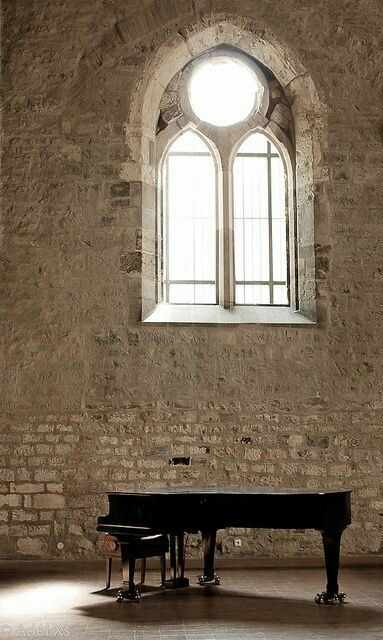
This week’s challenge is “Worship” hosted by Frank from Dutch Goes the Photo. My photos for this week’s challenge would not win any contests or strike awe in the viewer, but they do capture true worship in action, not the shadow of a place where worship once took place, however romantic that haunting scene may now appear.

You know, the funny thing is, I’ve been involved in church music for most of my life, but I’ve been hard pressed to find a photo of someone seated at the piano during an actual worship service. I have a growing collection of photos of church buildings, but almost no representatives of the worship that takes place on the inside, and particularly at the piano bench. I suppose that’s because it’s hard to take pictures while worshiping, and especially while playing. 🙂 But here’s one that someone else took and gave to me, taken from close to the back of the sanctuary. It’s rather small, I know, but this tiny frame holds some huge memories for yours truly.

music ministry

Nearly 1,000 miles separate me from that congregation now, but as I look at the photo, I can hear the music coming from the baby grand piano, blending nicely with the crisp tones of Jimmy’s trumpet. As the song of praise draws to its dramatic conclusion, a chorus of amens echoes throughout the pews, then the pastor rises to the pulpit to continue the service with a message from God’s Word.

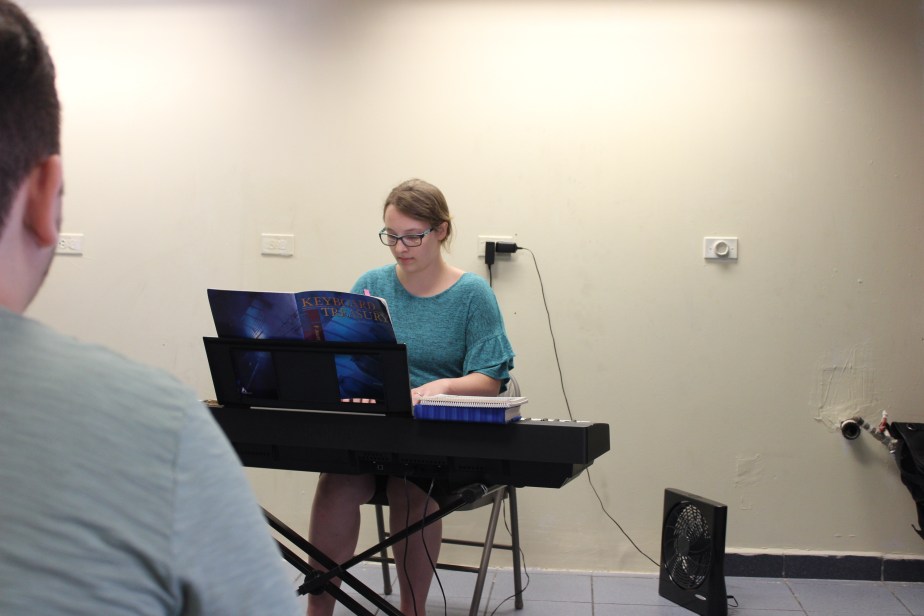
Below is another example of piano worship. This one was taken just last summer, when my daughter and I went to Mexico to visit some dear, sweet missionary friends, Tom and Jean Zartman, in Monterrey. Mary and I sang a duet, and she played a piano solo in the Sunday morning service, which meets in the lower floor of a dance studio. As you see, it’s not the building that matters, but the people. This church—this congregation—meets three times throughout the week, in three different places. But they are the same church. This serves to remind me that the church is not a building, but a body of believers who join together to worship the Lord Jesus Christ and sing His praises.

Where will you worship this coming Sunday?

Young lady playing solo on keyboard


Thanks again to Cee Neuner for her amazing directory, “For the Love of Challenges.” For the record, Cee’s directory lists not only photo challenges, but also writing and music challenges as well, and they are grouped by category. It’s very well organized.

Piano Passion — Tonya LaLonde

When I was younger, the Lord, art, and nature were my great passions. Not much has changed except that awkward 20-year phase where men snuck into that mix. I love my family now, adore my children, but more rare-for-this-season moments of passion still center around the Lord, art, nature and music. I love playing the […]

via Piano Passion — Tonya LaLonde

From the Studio: Piano Headboard

headboard made from an old pianoIt’s always exciting when someone asks for a custom order. Such was the case with the headboard. I had made a mirrored coat rack from the music shelf of the Lyon & Healy piano and took it with me to a craft fair. A lady saw it, and it gave her an idea for something special she could do for her mother, who was a retired piano teacher. Her mother lived with her in her home, and she slept in a hospital bed to aid in her comfort. But the bed did not have a headboard. So the lady visiting my craft fair booth wondered if I could make a headboard from a piano music shelf. I told her I would try.

At home I looked at the other pieces I had from other pianos. Most of them were in poor condition, and I was inexperienced at that sort of restoration. So I began to shop around, mostly looking at the local listings on Craigslist. Pretty soon I found a piano near me at a price that I could afford, and I purchased it. So it was that I came across this beautiful Royal Cabinet Grand. Incidentally, this is also when I learned that the tallest of the upriRoyal Cabinet Grand (1)ght pianos are actually grand pianos built vertically—hence the term “upright grand.” I call this one a cabinet grand because that is the name so designated on the piano.

My sons helped me get it home, and I went to work right away to build the headboard.

The first question to determine was how long the headboard should be. It was going to be longer than the bed was wide, no question about it. I removed the music shelf and the side pedestals from the piano, laid them out on the floor of my studio, then took pictures of them to send to my customer to show her what I had found. I also wanted her opinion as to whether to include the pedestals as part of the headboard. They would add visual interest, but they would also add width to an already too-wide headboard. She liked the look, however, so the pedestals stayed.

piano music shelf to become a headboard

As with the coat rack I had built from the other piano, I flipped the music shelf upside down so the actual shelf would be up top.

On the piano, the music shelf had been hinged near the center, and the pedestal had been attached to the cabinet. In order to attach the pedestals to the shelf, I used key extensions on the back, which were secured with screws (from the piano action) and wood glue.

The headboard was not going to be attached to the bed, but was only going to lean against the wall behind it. Since the headboard had a gorgeous red mahogany finish, I went to the local hardware store to purchase a length of mahogany 2×4 wood to make the legs. They would be hidden by the bed, but just the same, I wanted them to suit the headboard. With a coat of stain for the legs and the key extensions on the back, everything was beginning to look quite nice. I attached the legs with antiqued brackets, and moved on to the finishing touches.

The next step was to conceal all the minor scratches and flaws. Then taking some green felt that I had removed from the piano and cleaned, I applied it to the places where the headboard would rest against the wall, to prevent any marks on the same. We bought a set of sliders to go under the legs, and the headboard was finished and ready for delivery.

This slideshow requires JavaScript.

It was a happy day when I got to meet the lady who would enjoy this piano headboard. I put it in her room, and listened with delight to some of her stories of her glory days as a pianist and teacher. My friends, that’s what piano art is all about.

Weekly Photo Challenge: Pull Up a Seat

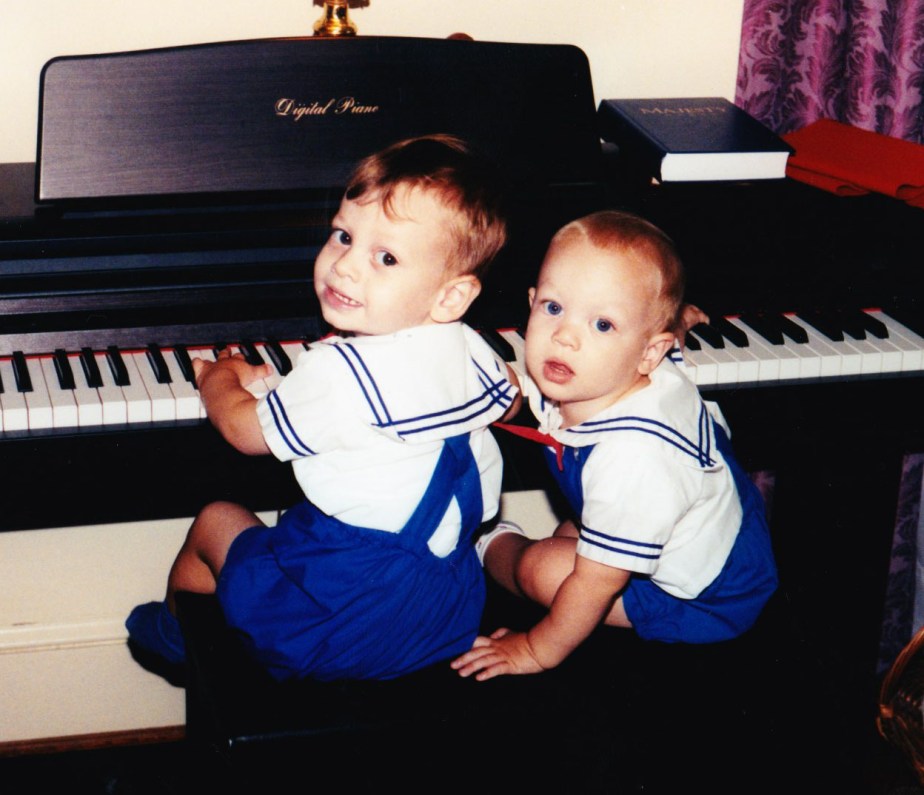
This week’s challenge is “Pull Up a Seat, Week 14” hosted by XingfuMama. I just “happen” to have a few photos of people—and a fur baby—seated at the piano. What a coincidence! 🙂

These two handsome prodigies are soon to be 21 and 22 years old. And yes, they are none other than my piano movers, whom you’ve seen featured in other stories.

two young boys sitting at the piano

The cat looks like I feel sometimes: “That’s too hard. I think I’ll go sip a cup of tea and enjoy a good book instead.”

Cat at Piano

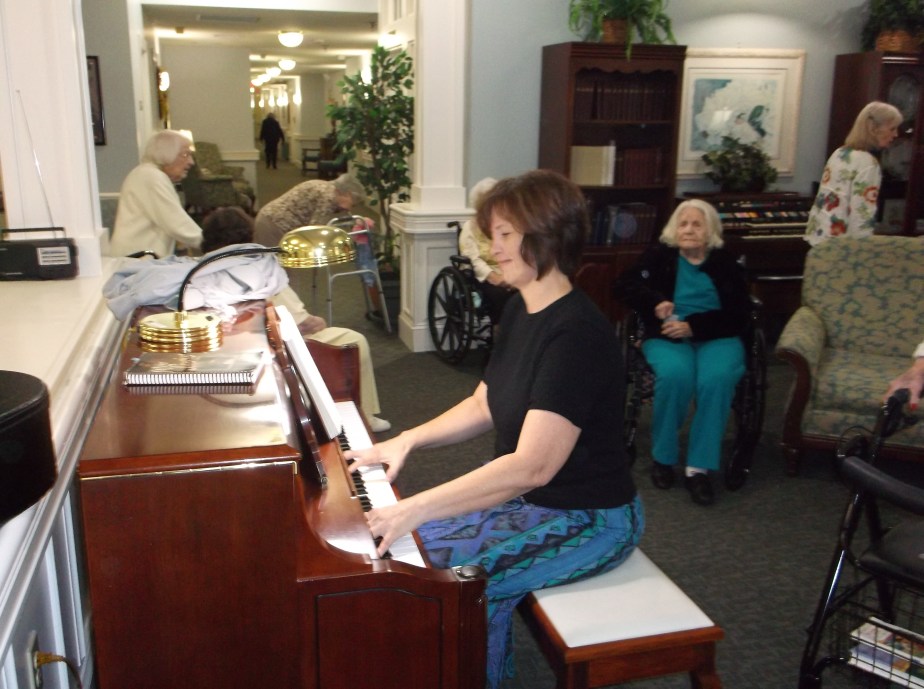
In this third photo is yours truly, back when I had the privilege of playing the piano at a nursing home in Virginia.

06 Chesapeake Place

Thanks again to Cee Neuner for her amazing directory, “For the Love of Challenges.” For the record, Cee’s directory lists not only photo challenges, but also writing and music challenges as well, and they are grouped by category. It’s very well organized.

A Brief Reign for the Royal Piano Company


The Royal Piano Company did not exist a long time, and information regarding their organization and operation is hard to find. But in their short span on the industrial scene, they produced some of the finest musical instruments America has ever seen. Royal was established around 1895 and manufactured fine quality pianos for about half a century, producing a full line of uprights, player pianos, and baby grands. They also built pump organs in the early years of the company’s existence.

Royal was originally a division of the Krell Piano Company, and it was bought out by Werner Industries of Cincinnati shortly before 1920. The Starr Piano Company purchased the Royal brand in 1927, and thus kept the Royal name alive during the Great Depression.

The last Royal piano was built in 1949. Today they are rare, but if you happen upon one, you will find it to be an example of quality workmanship.

The One I Acquired
Royal Cabinet Grand (1)

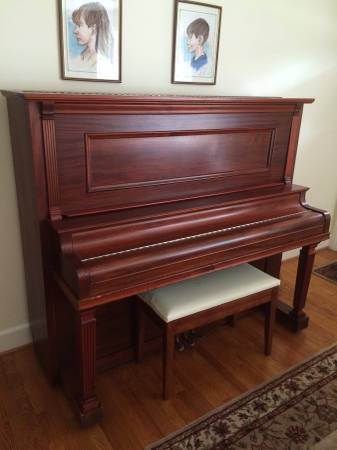
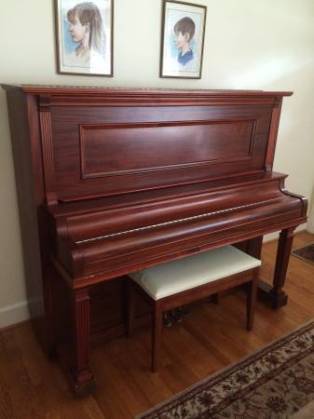
The Royal Cabinet Grand that came into my possession was not a gift, but was actually the only piano to date for which I have put down money (apart from moving expenses). I had been commissioned to make a headboard for a retired piano teacher who was confined to a hospital bed in her room. The former teacher’s daughter saw a coat rack that I had made from the music shelf of the Lyon & Healy, and she thought a headboard would be perfect for her mother, who had devoted her life to teaching others how to play the piano. How could I say no? I had several large pieces at hand, but none worthy of such an assignment. So I searched eBay, Craigslist, and other local listings until I found the perfect piano. It wasn’t free, but it was affordable.

Since I purchased the piano with a particular project in mind—the headboard, the majority of my photos of this piano are focused on the music shelf. Evidently, I didn’t even think to take a photo of the serial number, which is something I ordinarily do with every piano. Or if I did, I didn’t file the photo correctly. Unfortunately, that number is long gone by now, so I’ll never be able to determine exactly when this piano was made.

But there is a silver lining, for maybe someday, in a bin in the garage, I’ll find the cast iron plate that bears the Royal name. For I noticed in one of the photos that I removed the plate before letting Bobby haul the frame to the scrap yard. And in my search for information about the Royal Piano Company, I found a similar plate on a estate sale website that sold for over $200. Wouldn’t that be nice…. ☺

It has been noted that Royal pianos are known for their fine craftsmanship. I can definitely attest to this. At this point, I don’t remember which hammers, whippens, or stickers in my bins came out of the Royal Cabinet Grand, but I do remember the wood case, that it was both beautiful and solid. When we were preparing to move, some of my pieces got rained on, and I was horrified to learn (when the pieces swelled) that two of the pianos were partially built with press board! I was shocked! Most of them were not, however, and the Royal is most certainly made of solid wood. I don’t know for sure what kind of wood it is, but it is a hardwood. My saw and drill can attest to that (and my tired arm). Yet the most impressive thing to me—especially after taking apart thirteen pianos thus far—is not the fact that the cabinet is solid, or that it is made of hardwood, but the thickness of the wood, especially on the sides of the cabinet. On every piano, the side arm (the part that often resembles a grand piano in its shape) is nearly two inches thick, but the side board (the board that covers the length of the piano) is usually less than one inch thick, though it may have some trim along the edge to give the appearance of extra thickness. On the Royal Cabinet Grand, the entire side board was as thick as the side arm—just under two inches. And the cabinet’s finish was a gorgeous red mahogany.


The wood of the side board was too thick to use in large pieces, but too nice not to use at all. So I cut the wood into blocks measuring 6″ x 7.5″ and made game boards out of them, using tuning pins as the playing pieces. The concept was fairly easy to devise, but the implementation turned out to be difficult with hand tools. I made five games last year. They were imperfect at best, but my husband was impressed enough to purchase a drill press and power sander for me so that my next batch of board games will come out a lot nicer. Isn’t he sweet! Royal Cabinet Grand (1)
Of the thirteen pianos I’ve disassembled so far, the Royal Cabinet Grand is the only one to give me good quality wood that I can use to make these board games. Hopefully I’ll come across more pianos built with this level of quality in the near future.

If you happen to have a Royal piano, by all means keep it and treasure it. Tune it. Play it. Enjoy it. Pass it down to your children and their children after them. Don’t let it go the Piano Lady to be cut up and made into headboards, games, and art—not unless it absolutely must be thrown away. In that case, do call me first (if you live within 200 miles of Pensacola, FL). But please know that I no longer purchase pianos. I will, however, thank you for your donation by making you a souvenir piece of art from your piano.


Bibliography

Pierce, W. Robert. Pierce Piano Atlas. 12th Edition. Larry E. Ashley Publishing: Albuquerque, NM, 2008

antiquepianoshop.com

coolpianostuff.com

sweeneypiano.com

The Premier Estate Sale Marketplace


Recycled Piano Becomes Upcycled Workbench — Hackaday

Pianos are free, in case you’re not hip to the exciting world of musical instrument salvage. Yes, the home piano, once the pinnacle of upper middle class appreciation of the arts, is no longer. The piano your great aunt bought in 1963 is just taking up space, and it’s not …read more

via Recycled Piano Becomes Upcycled Workbench — Hackaday

Weekly Photo Challenge: Vertical

What I like most about things vertical is that they remind me to look up.

Luke 21:28b  Look up, and lift up your heads, for your redemption draws near.

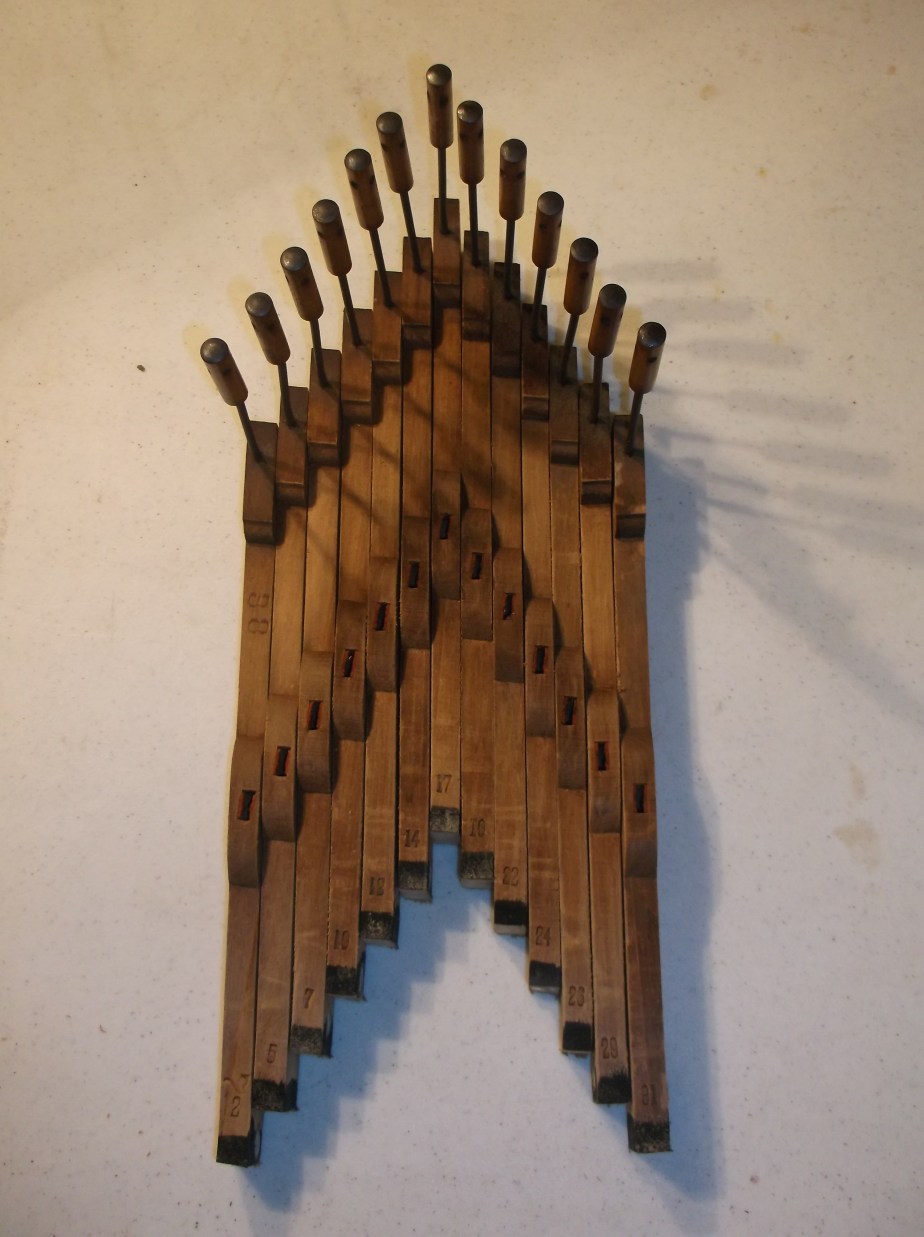
piano key extensions in an arrow formation
Fermata

This week’s challenge is hosted by Travel with Intent, and the theme is VERTICAL. This is another no-brainer in the realm of old pianos, as an alternate way to describe upright pianos is to call them verticals.

However, since I’ve used a good many photos of my pianos already, I decided this week to show other examples of “vertical,” such as the arrangement of key extensions above. It’s been given a name, “Fermata,” although it only slightly bears a resemblance to the musical symbol. The only trouble with this piece is that it has yet to be finished. It’s only in the planning stage. Maybe someday…. One day I arranged the pieces on the table and took a picture of them, trying to decide if I actually wanted to create a work with this design. What do you think? Feel free to leave your comments or suggestions below.

This next photo is my piano moving team: Matthew, Bobby, and Dolly. Dolly does most of the heavy lifting, but she and I couldn’t do anything without Matthew and Bobby.

two young men standing on a piano dolly
workers at play

Thanks again to Cee Neuner for her amazing directory, “For the Love of Challenges.” For the record, Cee’s directory lists not only photo challenges, but also writing and music challenges as well, and they are grouped by category. It’s very well organized.