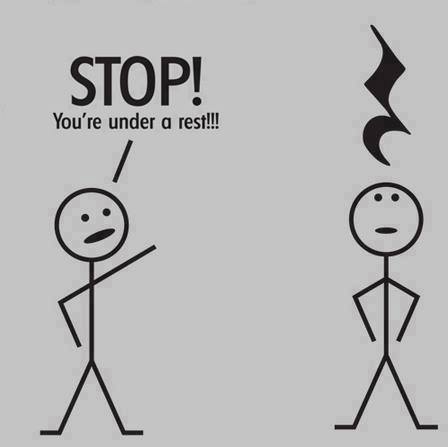
I’m sorry I cannot give credit to the artist. I found this years ago and pinned it onto the bulletin board in the music room at church. Just now I found it again in my photo folder and decided to share a smile with you.
Encore! Old Pianos with a New Song
Giving new purpose to old pianos

I’m sorry I cannot give credit to the artist. I found this years ago and pinned it onto the bulletin board in the music room at church. Just now I found it again in my photo folder and decided to share a smile with you.
Welcome back to my piano art studio. Today I’d like to share with you the power of a friendly suggestion.
I was cleaning up my side of the garage one day, and came across a piano desk. This is not a writing desk, but the piece of wood from inside the piano which supports the keys. This piece is utilitarian, but not pretty, and I was going to throw it away. It wouldn’t fit inside the trash bin, so I ran several passes on the table saw to cut it into more manageable pieces. That was when inspiration began to flow again.
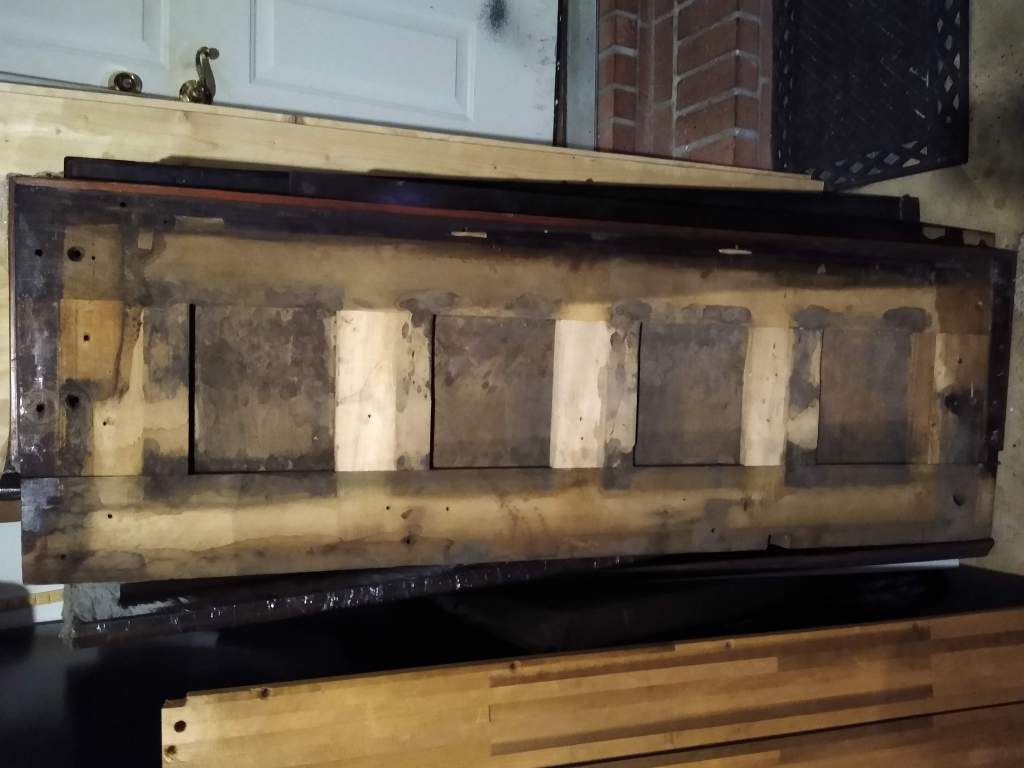
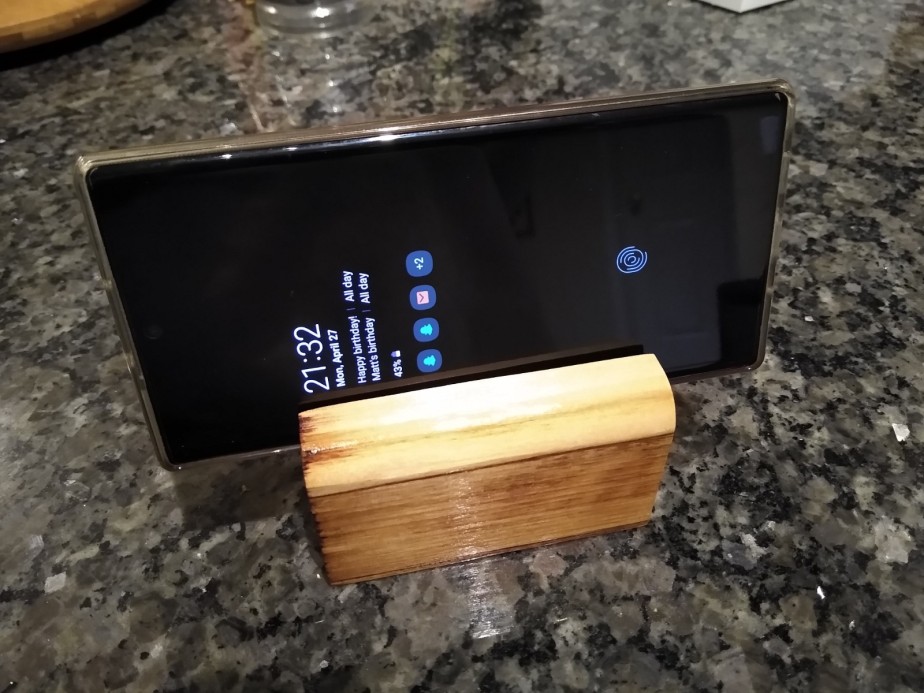
The piece somewhat resembles a four-panel door, with several lengths of two-inch thick wood and three sheets of thin wood running down the center. As I cut the desk, these thin wood panels slipped easily out of the grooves that had held them in place. I picked up the small pieces, which now had a groove in them, and thought immediately that these could be made into cell phone holders. Other uses became apparent for my new scraps; and before I knew it, I was placing every piece on the shelf instead of in the trash bin.
The groove wasn’t actually wide enough for a phone with a case, nor did it have a good angle. But again I put the table saw to use, making several passes over the blade until the groove was just the way I wanted it. I sanded the block down and tried it out. It worked fairly well when the phone was in the landscape position, but most of them fell over when I positioned the phone vertically. To fix this, I added “feet” to the bottom, each one made by gluing together two jacks. To my delight, these feet could also hold a cell phone, so now my mount could support two phones at once. I also thought this little device could work just as well to hold business cards, making it even more versatile.
I showed my latest creation to my children, and they loved it. My son Matthew suggested that I drill a hole coming up from the bottom so that a power cord could run through, making the cell phone holder a charging station. It took some doing, but I made it happen. After more sanding and a couple coats of varnish, the cell phone holders were finished.


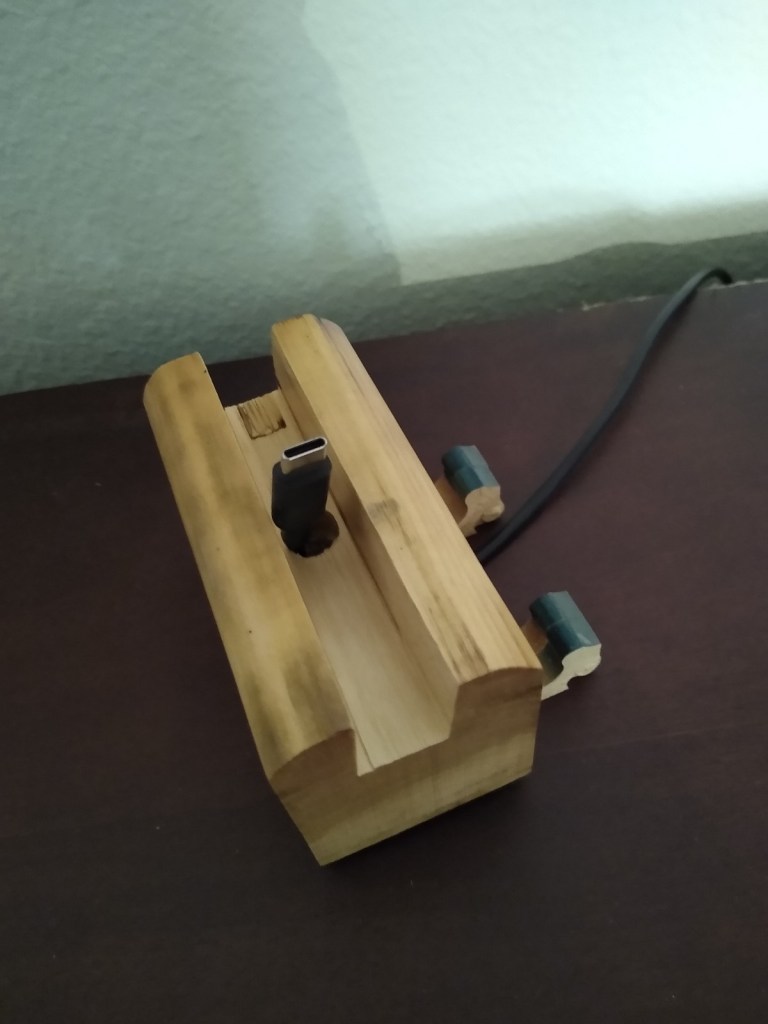

To me, the hardest part of any new creation is giving it a name. My inclination is to theme the title after music theory or a popular song title. This time I deviated just a little bit from that, and called it “Hold the Phone,” since that is its intended purpose.
“Hold the Phone” is available in my Etsy shop. So put your call on hold and click over to the shop now, while these babies are still available. Whether for your phone or your business cards, “Hold the Phone” is the right choice for you. Get one for your office desk and another for your night stand. Your phone will thank you for giving it a place to call home.
Thank you for joining me on this tour of the studio. I look forward to seeing you on the next one. Until then, I invite you to check out photos of my other work in the gallery. Enjoy the rest of your day!
Welcome back to my piano art studio. Today I’d like to share with you something that came out of a day of cleaning and organizing.
By the time I had taken apart 18 pianos, as you can well imagine, I had thousands of action pieces lying around. Actually, they were in boxes in the garage, and not easily accessible when I wanted to use them in the studio. My sweet husband bought me a 10-drawer crafting organizer. I had seen them but thought they were a bit pricey. He found one at a good price, and I love it! (May I have two?) It took a while to decide which pieces would go in the drawers, but by the end of the day, each drawer was both filled to capacity and labeled. I didn’t empty my boxes, but at least I finally had a selection of pieces that were now readily accessible.


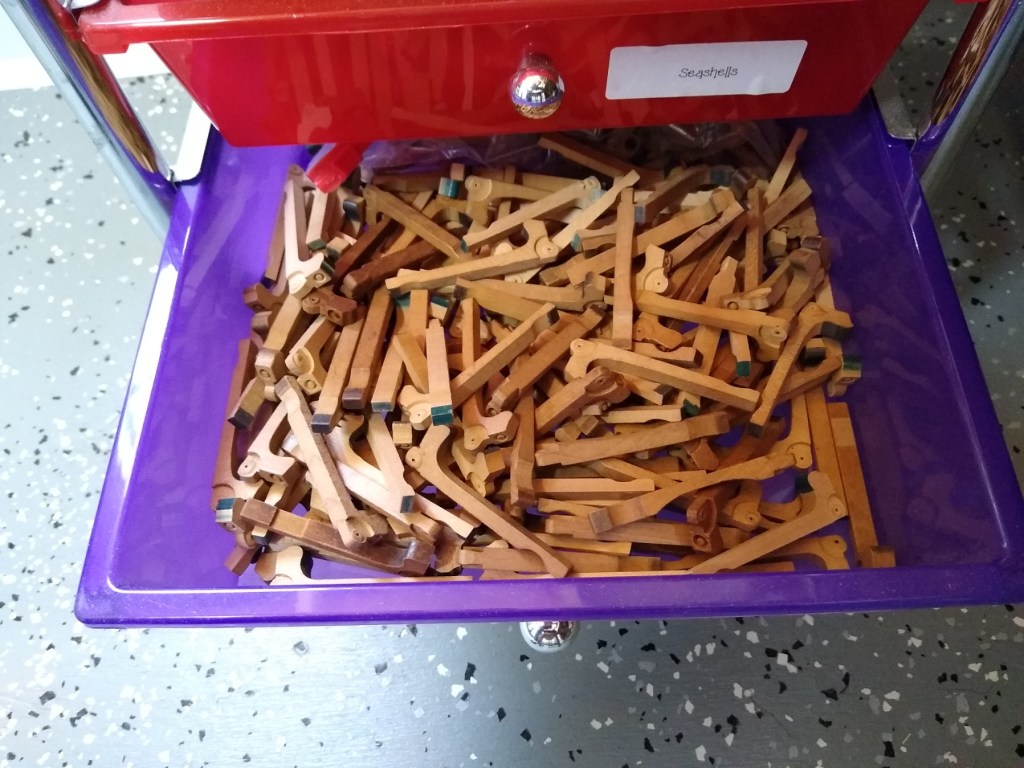
But I don’t disassemble, clean, and sort piano pieces for the fun of it. If I don’t use them in my art, they serve no purpose. The same holds true for canvases. At one point I went crazy buying canvases, getting fully stocked up on 16×20, 11×14, and 4×4 gallery-wrapped canvases. Then all of a sudden, I decided to rework the things I’d been creating on the 4×4 canvases. I normally use them in sets of 4, but I got tired of having to hang all four of them individually. My options were to connect them or use a single 8 x 8 canvas. It would be both cheaper and easier to use the single, larger canvas, but that left me with a couple dozen 4×4 canvases and nothing to do with them. I needed a new idea.
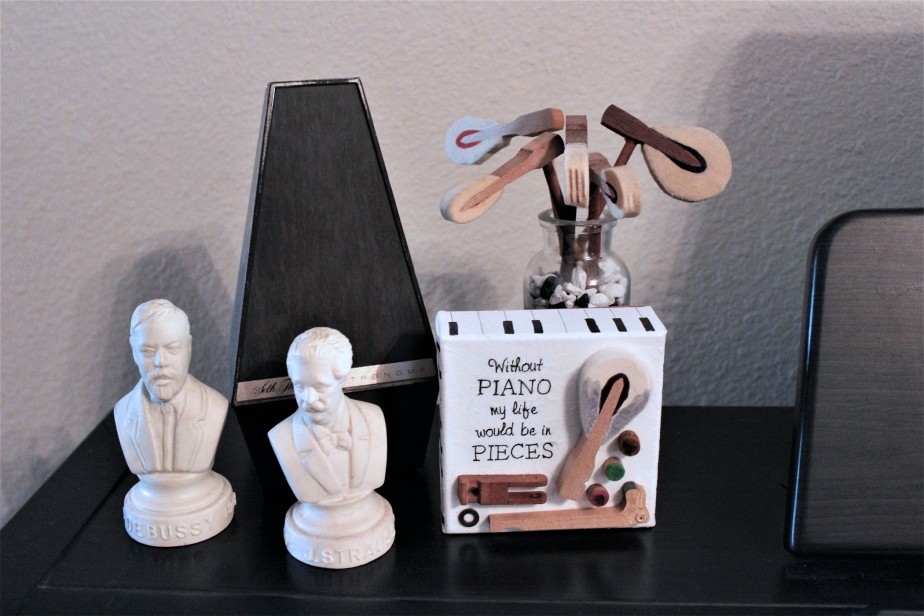
An unopened package of 4×4 canvases was sitting idly by, not far from my 10-drawer organizer. On a hunch, I opened the drawers one at a time and pulled out any piece small enough to fit on the canvas: a hammer (minus the shank and butt), a jack, a few flanges, and a metal washer. With these arranged on top of the still-shrink-wrapped canvases, I also began brainstorming, searching for a catchy phrase that isn’t already overused in the market. I wrote directly onto the shrink wrap packaging, to get a rough idea of what the finished product could look like. While toying with the arrangement of these sundry piano pieces, I thought, “Without piano, my life would be in pieces.” With an emphasis on the words “piano” and “pieces,” this would be perfect!

Normally when I add text to my work, I do it freehand. But this time I decided to try something new (to me). In one of the many YouTube tutorials I’ve watched recently, I saw a lady applying a decorative napkin to a canvas using decoupage. I decided to try that here as well, only I’d be transferring letters instead of a picture. I typed up my phrase several times, experimenting with different fonts. When I found a few that I liked, I transferred (traced) them onto a napkin, then glued the napkin to the top of the canvas. I covered the entire surface with the napkin, although the wording was only in one section. This gave a uniform textured appearance all the way across.
The background is white, and the entire surface is sealed with a gloss varnish. The canvas is deep enough to stand sturdily on your desk or shelf, while a sawtooth hanger on the back also allows for hanging on the wall.

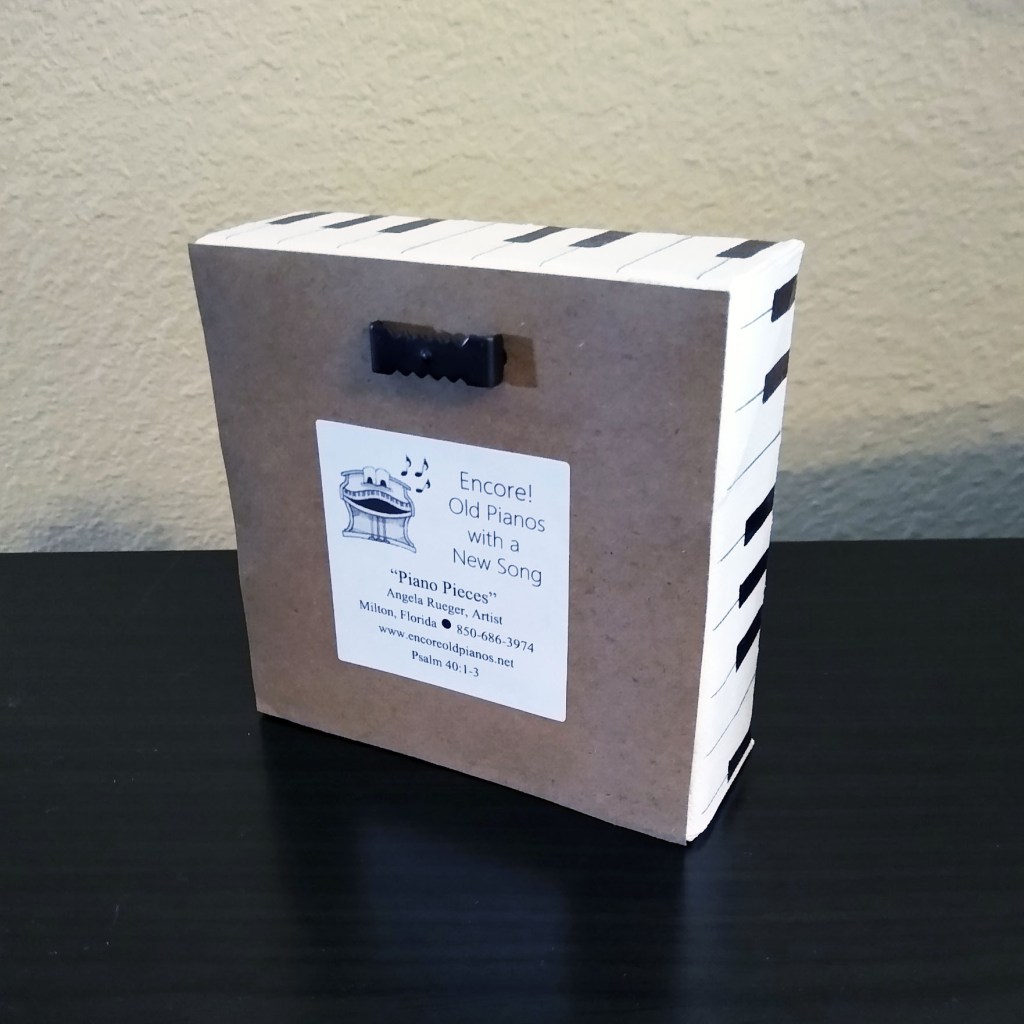


That’s easy. Just click over to my shop and make your selection. In this listing of “Piano Pieces,” you’ll have a choice of a couple variations in font, since I couldn’t make my mind up on just one.
Thank you for joining me on this tour of the studio. I look forward to seeing you on the next one. Until then, I invite you to check out photos of my other work in the gallery. Enjoy the rest of your day!

Music washes away from the soul the dust of everyday life.
Berthold Auerbach
Image courtesy of DesiComments.com
A few days ago I disassembled yet another piano action. More than 300 screws had to come out in order to release the more than 1,000 individual parts. The tedium of the task gives my mind a chance to focus on other things, usually whatever music I happen to be listening to at the time.
But this time I got to thinking about how all these parts usually stay hidden inside the piano. A pianist will see them if motivated by curiosity to open the cabinet and look inside. But more often, the musician will simply sit down and play. The outward and most obvious parts—the keys, pedals, cabinet, and even the bench—are important in making music. But no less so are the hidden parts—the hundreds of internal pieces that work together in one fluid motion to produce sound.

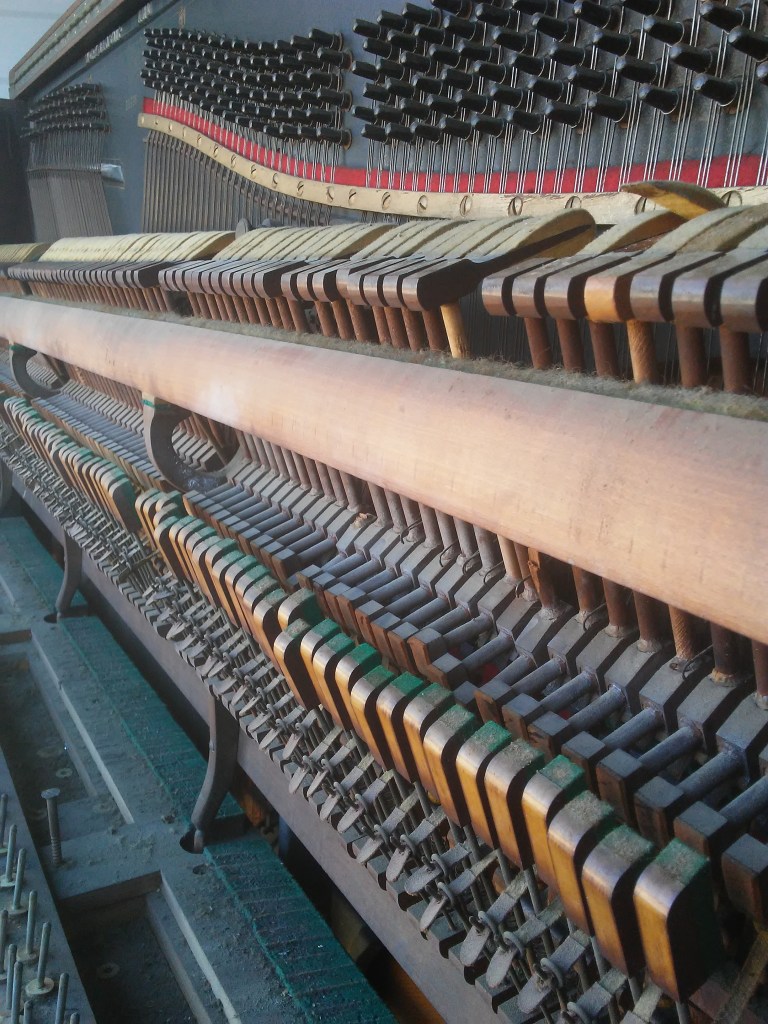
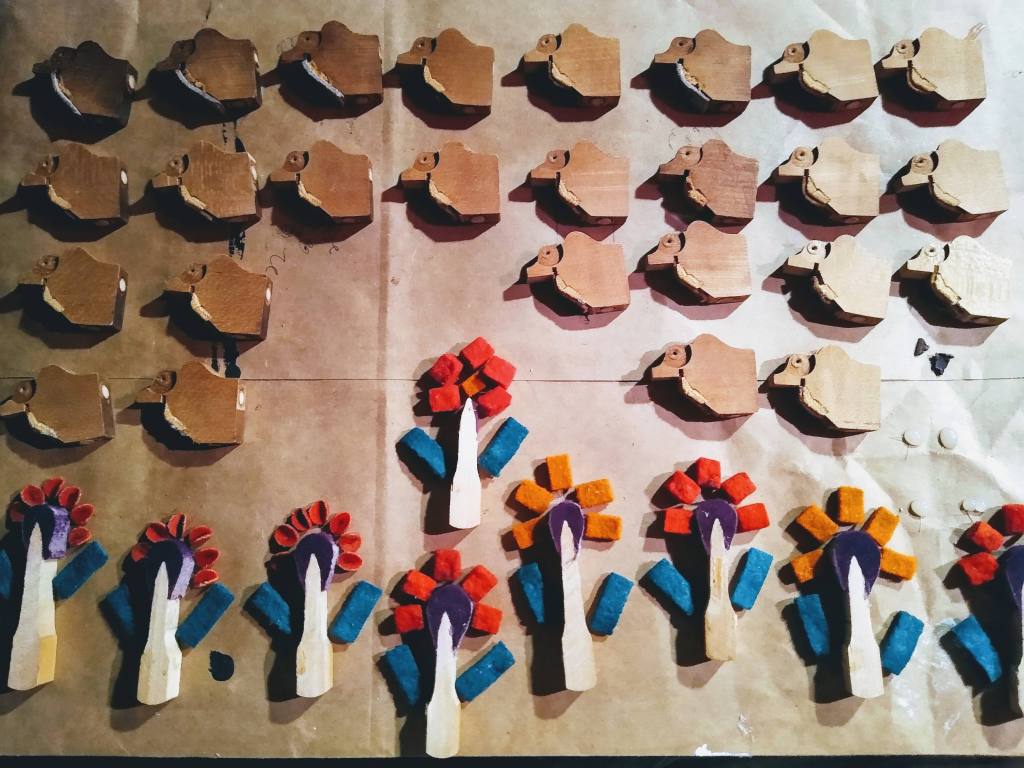

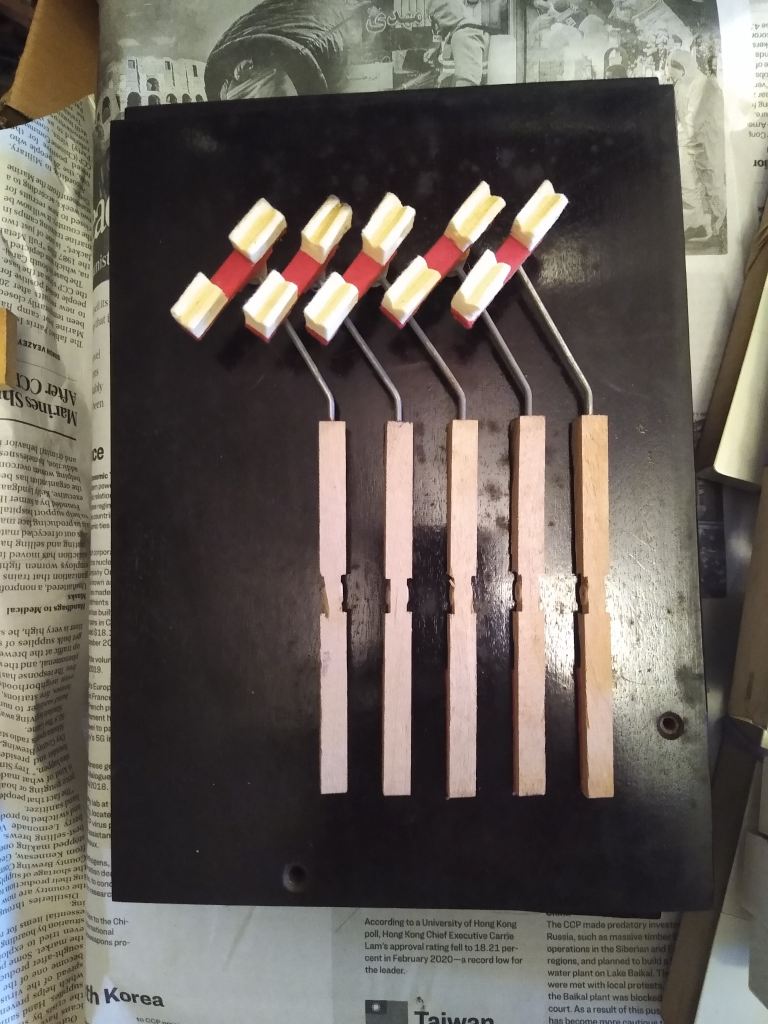
I have both outside and inside parts too. I tend to spend a lot of time with the outward parts—showering, dressing, primping, etc. These things are necessary, and the folks nearest to me thank me for tending to such details!
But what about the inside? those hidden parts? Do I give proper care to my heart, lungs, brain, digestive system, muscles, joints, and so forth? It’s important to get proper nutrition, exercise, and rest so that my body can function as intended.
And how about my mind? Do I fill it with things that make me a better person? or with things that will not matter even tomorrow, much less in a hundred years? It is my thoughts that guide my actions, and therefore I must pay close attention to what shapes those thoughts.
Now comes the most important hidden part of all—my soul. This is the real me. It’s the part of me that others come to know and love (or not). It’s the part of me that will live forever. The Bible says,
Behold, You desire truth in the inward parts: and in the hidden part You shall make me to know wisdom.
Psalm 51:6
There are those today who would have you believe that truth is what you make it. My friend, this is a lie! Truth is not relative; it is not subjective. If that were so, then I could easily lose unwanted pounds by simply deciding that gravity doesn’t apply to me.
God wants me to embrace His truth. How can I do this? By embracing His Word.
Sanctify them through Your truth: Your Word is truth.
John 17:17
My soul is rotten to the core. I am a sinner: I was born that way. You were too. But God offered you and me new life through the saving work of the Lord Jesus Christ. I accepted that offer. He forgave all my sin, and now He sees me as clean and wearing Christ’s spotless robe of righteousness. He teaches me to grow in grace daily, and to increase in wisdom.
My body is growing old and will eventually break or wear out, and then be laid to rest. But my soul will live forever somewhere. The eternal destiny of my soul is settled. What about yours? Have you even given it any thought?

Each one of us is God’s special work of art. Through us, He teaches and inspires, delights and encourages, informs and uplifts all those who view our lives. God, the master artist, is most concerned about expressing Himself—His thoughts and His intentions—through what He paints in our character…. [He] wants to paint a beautiful portrait of His Son in and through your life. A painting like no other in all of time.
Joni Eareckson Tada
Image by Rudy and Peter Skitterians from Pixabay
Welcome back to my piano art studio. Today’s feature combines a new-to-me technique with some seemingly hopeless piano pieces.
Rather than play games on my phone, I like to watch YouTube videos to get new ideas for my creative side. For weeks I binge watched about a half dozen different artists using the fluid acrylic painting technique. It was fascinating to see how the colors swirled around on the canvas. To be honest, at first it didn’t much look like “fine art” to me—you, know “anyone could do that”—until I tried it, that is. Getting the consistency right, getting the quantity right, spreading it around without causing the colors to combine, getting it to dry without cracks—all these things take practice. And yes, I’ve had some fails, as I’m sure the YouTubers have too. There is a learning curve, but it’s true that it’s a more attainable form of art than, say, portrait painting.
When I opened one of the pianos that were donated to me, I discovered that nearly all the felts had popped off the hammer cores. Most manufacturers staple them in place, but some use only glue, and glue does not hold up well to heat and high humidity. At first I thought I’d try to glue them back down, but then I found that the felts had also shrunk, since they had evidently been in this sad state for quite a while. So, I had no choice but to finish removing the felts from the hammers.
This left me with a lot of pieces I’d never used before. But given enough time, I found a use for them. To begin with, I cut the cores off the hammer shanks, cut the shanks off the butts, then sanded all the rough edges. The butts went into one drawer for future use, and the shanks went into another.
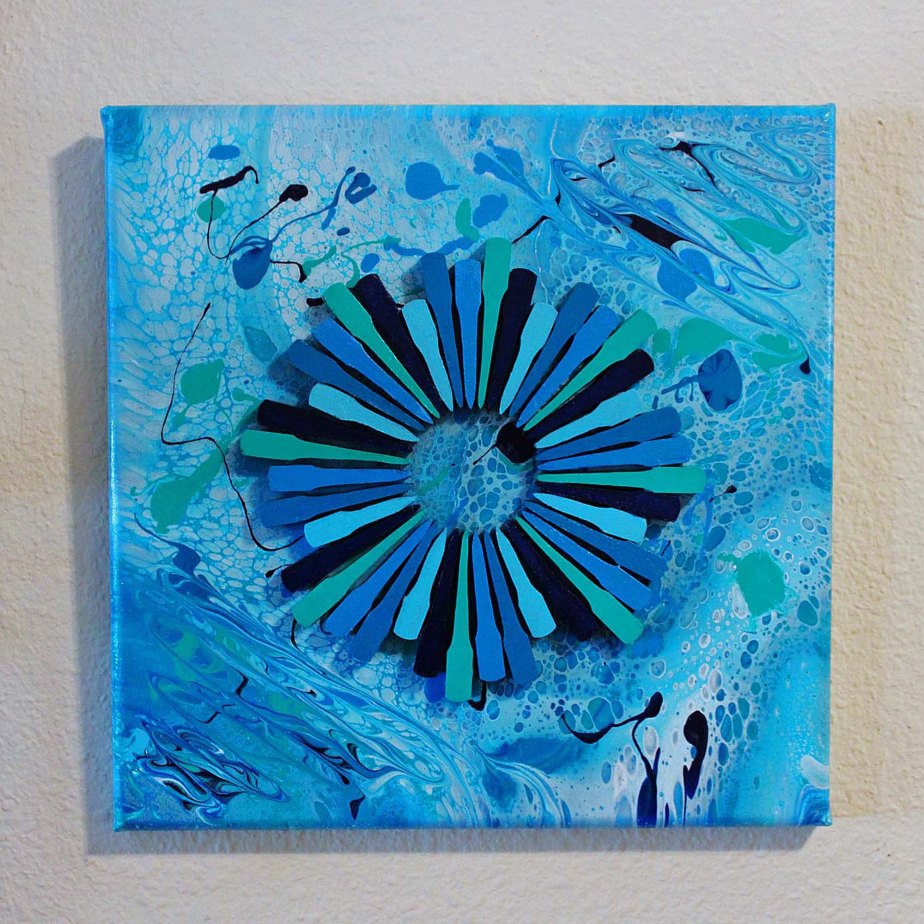
Then I turned my attention to the cores, and I discovered that they are not all the same size. The ones with ‘fat’ felts on them, which strike the heavy strings at the bottom of the keyboard, are short and stubby; while the cores that were once covered with thin felts (for the higher, thinner strings) are long and thin. And there is a third size in between those two for the hammers in the middle of the action.
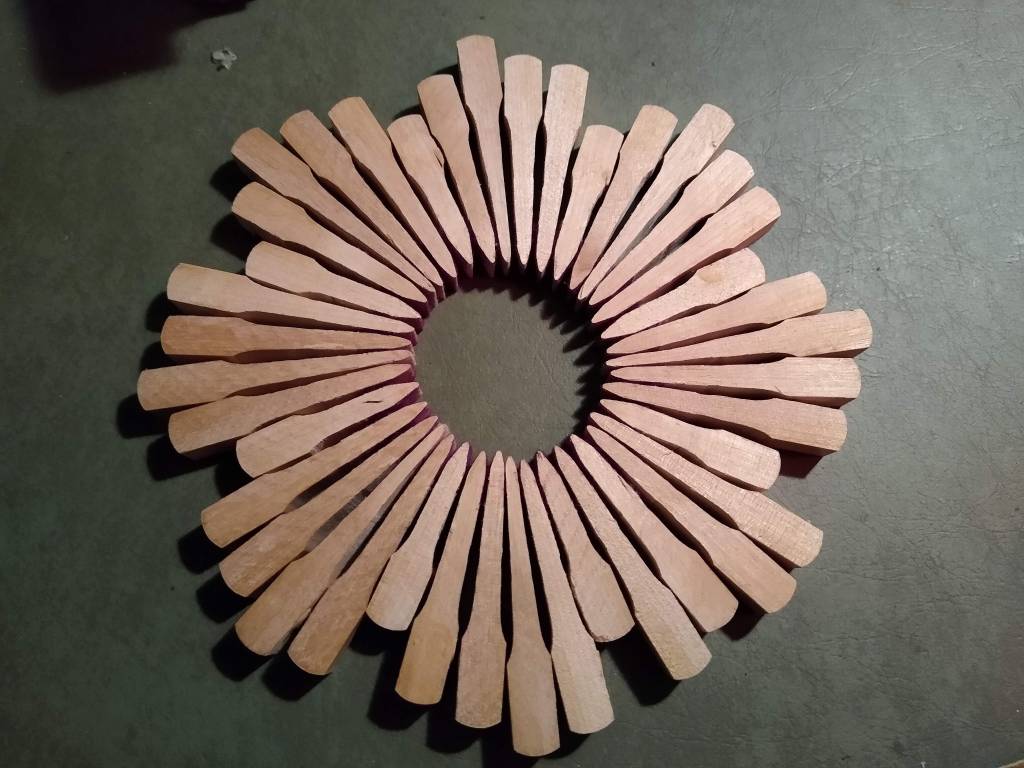


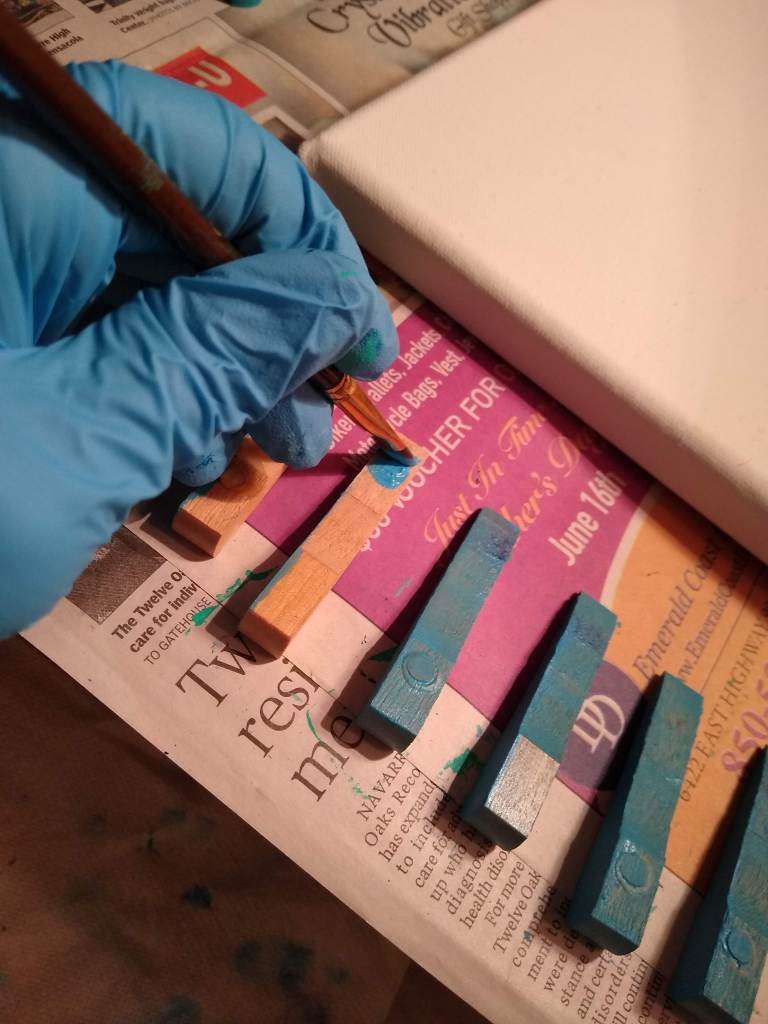

Because the acrylic pouring technique yields an illusion of fluidity, I decided that for my first paint pour I’d use the colors of the ocean. I made two of them, each on a 12″ x 12″ canvas, and not surprisingly, they look quite different from one another. For the first one, I painted the hammer cores from that sad piano, using the same colors that were in the watery background, then arranged them in a circle on top of the canvas. On the second canvas, I combined the cores from various pianos, both upright and grand, and so got a slightly different look. The grand piano hammers made the difference because they’re curved at the tail, as opposed to their stumpy upright counterparts.


For me the hardest part of creating something new is coming up with a name for it. Because my focus is pianos, I decided a long time ago to give each piece a music-themed title. Sometimes it’s a musical term that I think aptly describes what’s happening on the canvas. Other times it’s the name of a song. In this case, it’s a phrase from within a song. In fact, the song played through my mind constantly as I worked. It’s a hymn that has been set to a few different tunes, and it’s called “O the Deep, Deep Love of Jesus.” My church hymnal presents it with a traditional Gaelic melody (Bunessan) in the Key of C. But my favorite setting is the lovely minor key tune, Ebenezer, composed by Thomas J. Williams.
O the deep, deep love of Jesus,
Vast, unmeasured, boundless, free!
Rolling as a mighty ocean
In its fullness over me.
Underneath me, all around me
Is the current of His love;
Leading onward, leading homeward
To my glorious rest above.O the deep, love of Jesus;
Spread His praise from shore to shore!
How He loveth, ever loveth,
Changeth never, nevermore.
How He watches o’er His loved ones,
Died to call them all His own;
How for them He intercedeth,
Watcheth o’er them from the throne!O the deep, deep love of Jesus,
Trevor Francis
Love of ev’ry love the best!
‘Tis an ocean vast of blessing,
‘Tis a haven sweet of rest.
O the deep, deep love of Jesus,
‘Tis a heav’n of heav’ns to me;
And it lifts me up to glory,
For it lifts me up to Thee.
Now that you’ve read it, I invite you to listen to a stunning arrangement of my favorite arrangement of this song….
Both paintings are available for sale, the original and the second one.
Thank you for joining me on this tour of the studio. I look forward to seeing you on the next one. Until then, I invite you to check out photos of my other work in the gallery. Enjoy the rest of your day!
Welcome back to my piano art studio. Today I’d like to take you inside my head to see how I thought through the idea that eventually came to be known as “Love Letters.” I hope you enjoy the read.
One day as I was sorting through my bin of ivory keys, I found that I had attained quite an assortment of miscellaneous keys that had lost their ivory keytop heads. What am I going to do with these beauties?
To begin with, I need to sand the heads smooth. . . .
Ok, that’s done. Now what?
I browsed Pinterest and the home decor section of local stores, looking for ideas, and I saw several messages written out with wooden blocks.
I can do that! Each key will represent a block, and I can write the letters on the keytop heads.
But what will I write? What message should these musical blocks display? Ah, yes! “I love music.” It’s a no-brainer. And I’ll use a heart to represent the word “love.”
This will involve seven keys, so I’ll need seven paint colors. The heart will be red, so I want the background to be white. As for the others, I’m not sure just yet.
Upon counting the keys I had available, I decided to make two sets of I♡MUSIC. But I still had keys that were missing their keytop heads. In fact, I had 16 more. That would be enough for two more sets, but I’d have two left over. What other words could I make? How about “LOVE.” And I’m creating these to be home decor items, so the word “HOME” also sounds appropriate. I’ll make two of each: one in warm colors and the other in cool colors, to match any decor.


With chalk paint becoming more and more popular, I’ll try it out on these key-blocks. I went to the store and browsed the chalk paint selections, choosing six colors that coordinated with one another, plus black, white (plaster), and red. These will do nicely.
At home, I set out all the bottles of paint, rearranged them several times, taking pictures of the bottles to see how the colors looked when photographed. There. That’s good. When I had the colors arranged to my satisfaction, I carefully painted each head.
Next question: What font am I going to use for the letters? For help with that, I went back to Pinterest, browsed until I found a few different styles I liked, then practiced in my sketchbook. Yes, this one. I can duplicate it with ease, it’s easy to read, and it has a simple elegance to it.
When the paint was dry, I wrote letters on the keys, one on each head, and put them together to spell “I♡MUSIC,” “L♡VE,” and “HOME.” I made some available in cool tones and others in warm tones. I’m so pleased that the keys stand on their own and can be positioned however I like. When finished, I made them available for sale both online and locally.


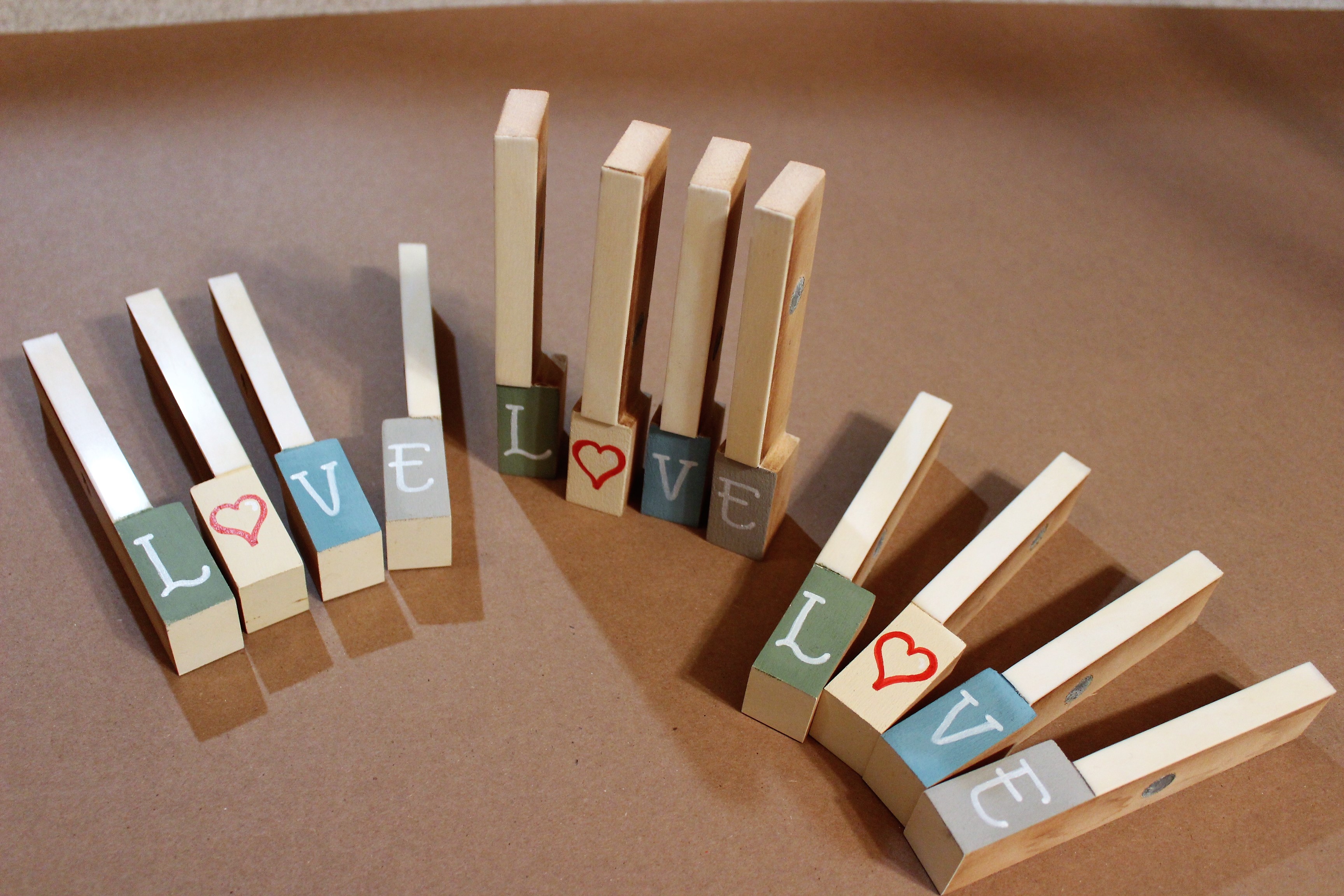


Several craft fairs later. . . These Love Letters are nice, but I’m getting tired of having to put out each individual key at every single craft fair. And the wind knocks them over. And they fall when people bump the table. If they annoy me, they’ll annoy my buyers. Imagine having to move each key individually when it comes time to dust! What a pain! It’s time to improve the design.
So I decided to glue them together. Ah, yes! an instant improvement. They do require a little reinforcement on the back, though, since they weren’t made to go together so closely. But I have lots of thin plywood on hand, so that’s not a problem.


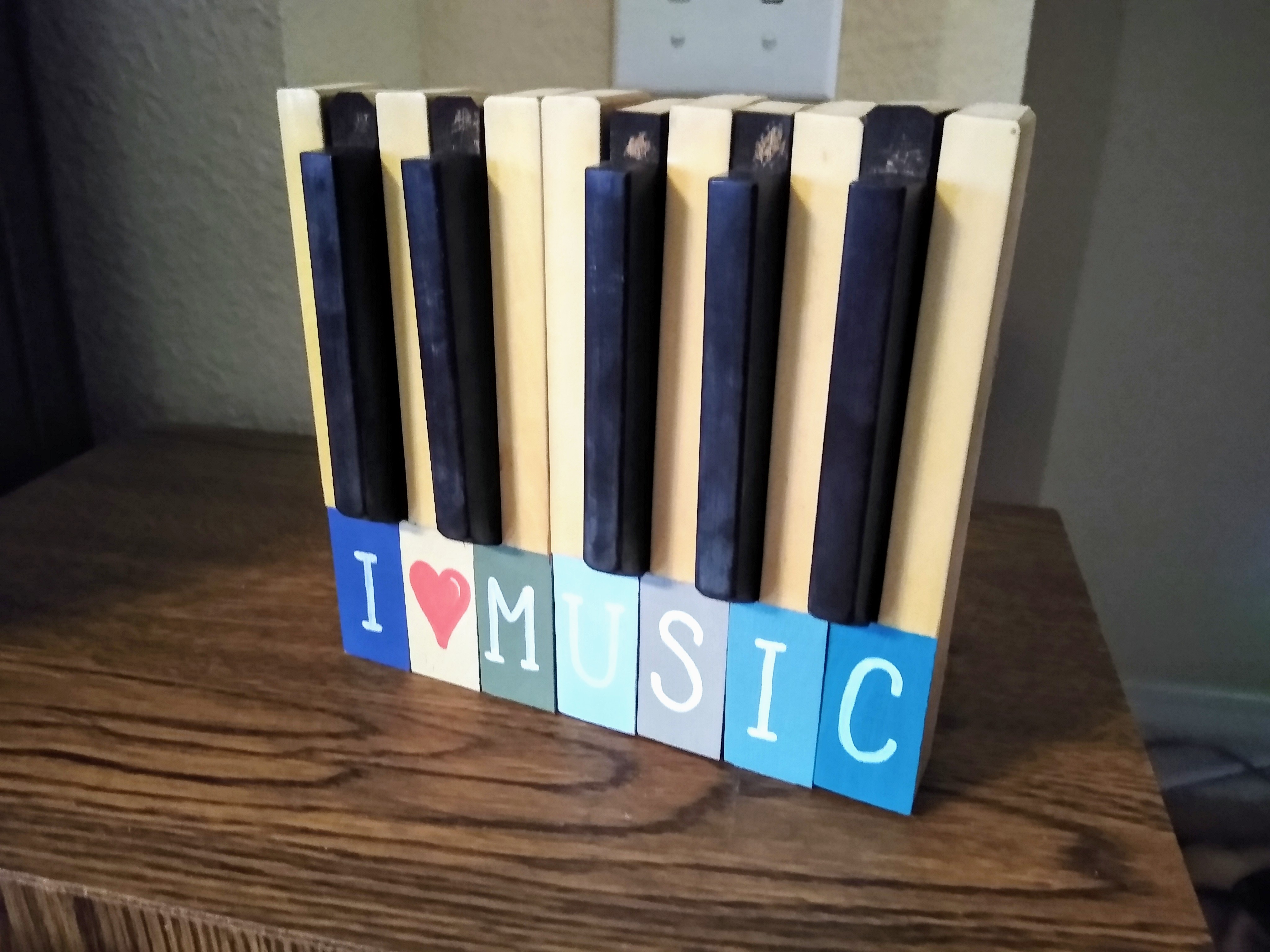
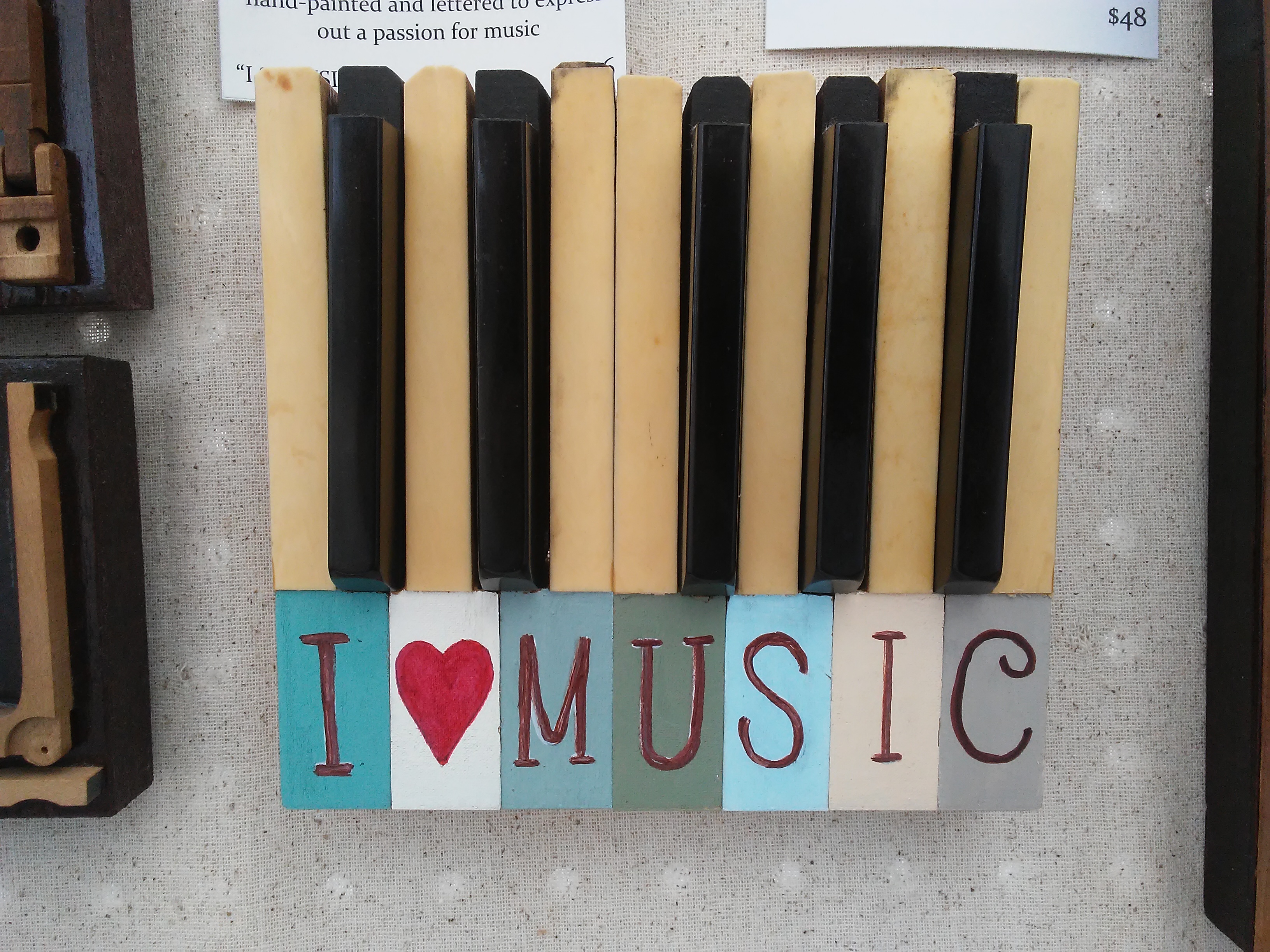
The next change came to the “I♡MUSIC” selection. My husband made a recommendation: “Why don’t you include the ebony keys between the ivories, as they appear on the piano?” Good idea. I’ve since made several that way. They do look nice, but they present another challenge to me: they have to come off the piano in proper order. The way I’ve been putting them together, the keys could be from anywhere on the keyboard. I’d simply gather the keys that were missing their keytop heads and mate them together. But ebony keys don’t fit between, say, two C keys. You have to have both C and D side by side. So while it’s possible to include the ebonies, I won’t make them that way exclusively from now on.
One advantage, however, to including the ebonies is that I can back the entire piece with thin plywood and install a sawtooth hanger, making the piece more versatile. For with a sawtooth hanger, the décor may either stand freely on a shelf or be displayed on the wall. Where there are no ebonies between the ivories, there isn’t a place to attach a sawtooth hanger. Granted, I could use two smaller hangers, one on each end. I’ll think about it. . . .
Some of the Love Letters are still in stock, including I♡MUSIC and HOME. Incidentally, I changed up HOME a bit, so that it now says, “With You I Am HOME.” I did this after hearing that expression used in not one, but two movies. It’s a sign! ☺
Thank you for joining me on this tour of the studio. I look forward to seeing you on the next one. Until then, I invite you to check out photos of my other work in the gallery. Enjoy the rest of your day!
Welcome back to my piano art studio! I’d like to share with you the power of a friendly suggestion.
One day a couple years ago my friend Adele approached me at church with a piece of piano art someone had given her. The scene was of a country road winding through the woods and beyond a small cottage—all this painted on an ivory keytop head, which measures less than 1 inch by 2 inches. I was amazed at the detail that could be captured in such a tiny painting. The setting was equally stunning, as the painted keytop was set on a background of black velvet and enclosed in a 2½” x 3½” frame. “I believe you can do this too,” she said.
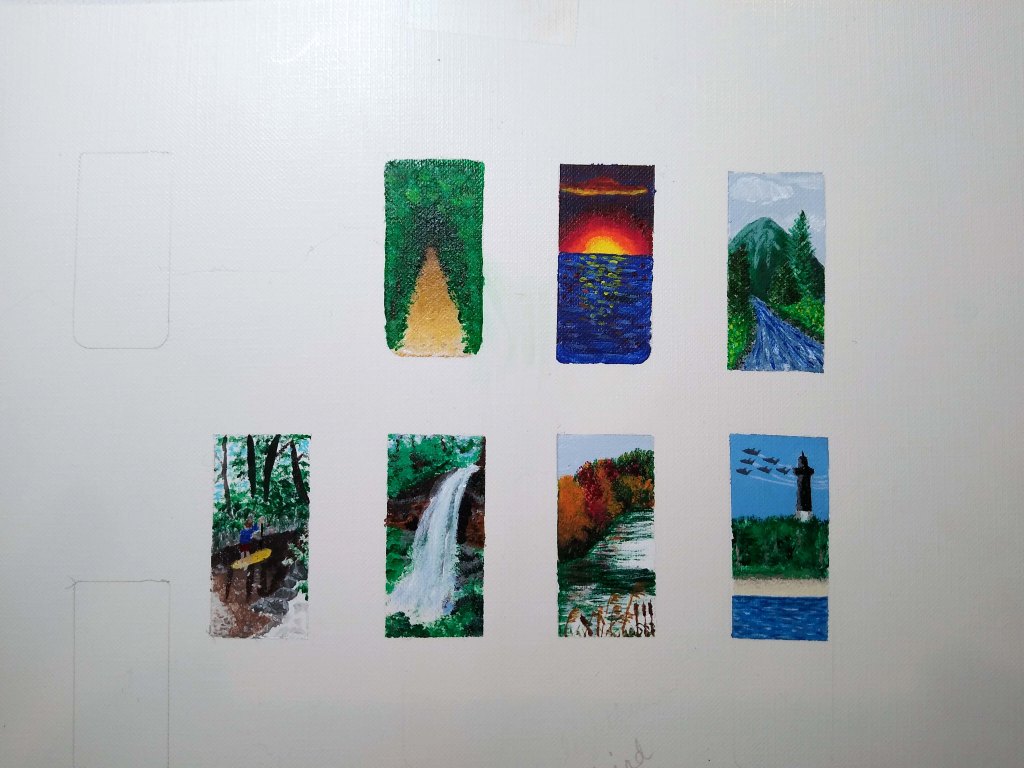
I’d never painted anything so small before, but I rose to the challenge. At home, I got out a sheet of canvas paper, traced several times around an ivory keytop head, then set about to paint a variety of settings within the constraints of my small rectangles. I wanted them to be my own, not a copy of the one my friend had shown me. Each setting was from a place I had been. Several were from photographs I’d taken, but a few came from my memory.
When I had painted seven scenes, I chose four of them to duplicate onto the actual ivories. I decided to create eight copies of each of scene, so I fastened 32 keytop heads to a paper sack with a small piece of rolled painter’s tape under each one.


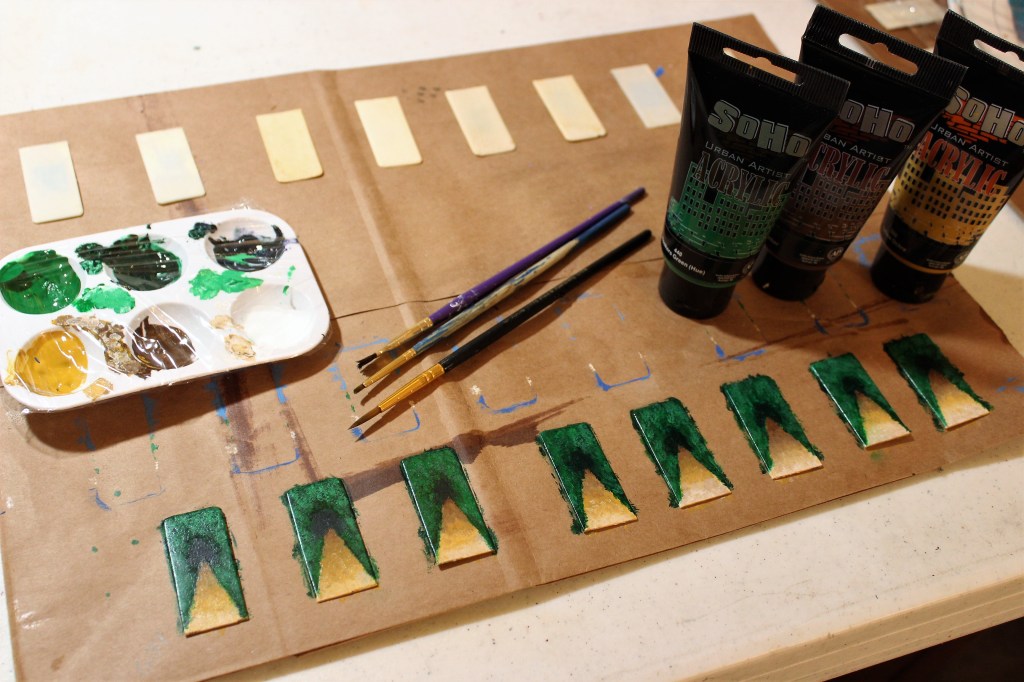
Right away I learned that painting on the smooth ivory surface is much different from painting on the canvas paper. It took layer upon layer of paint before the picture began to emerge. (Now I prep the keytop head with a coat of sealer before painting, as it gives me a better surface on which to apply the paint.) Then using my smallest (liner) brushes, I set out to create what I hoped would be masterpieces—or at least identifiable scenes from nature.
When the paintings were complete, I borrowed from the other artist’s idea of mounting the keytop head onto a piece of black velvet in a small frame. This size frame is easy to find, but finding one that doesn’t look cheap can be a challenge. I cut the fabric down to size and mounted it to a piece of sturdy cardboard, also cut to size. The glass that had come with the frame was set aside for a possible future use.

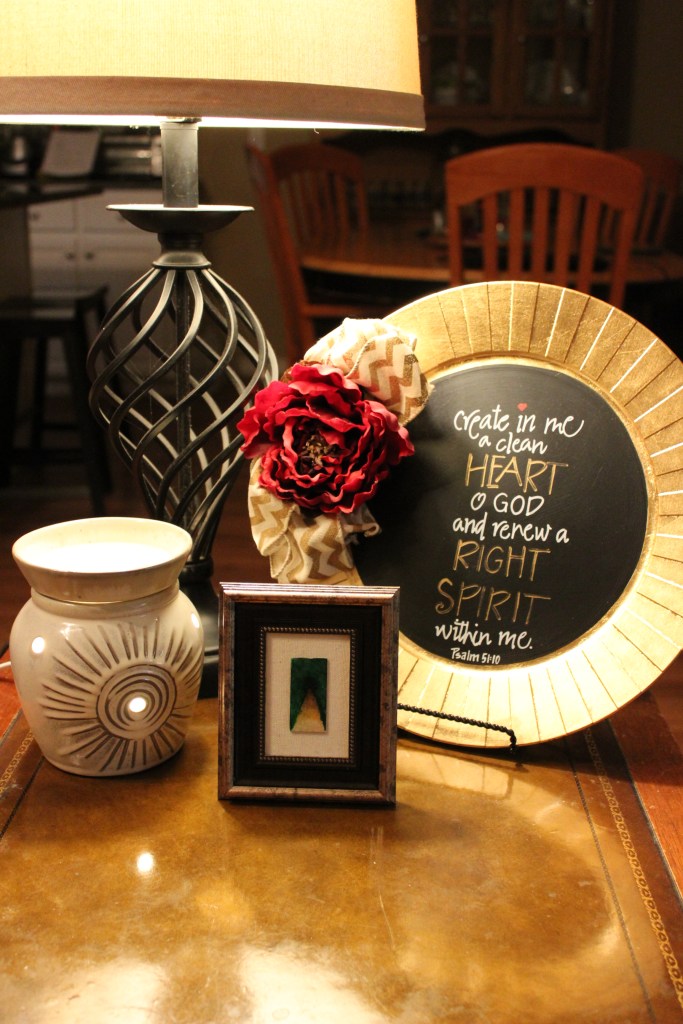
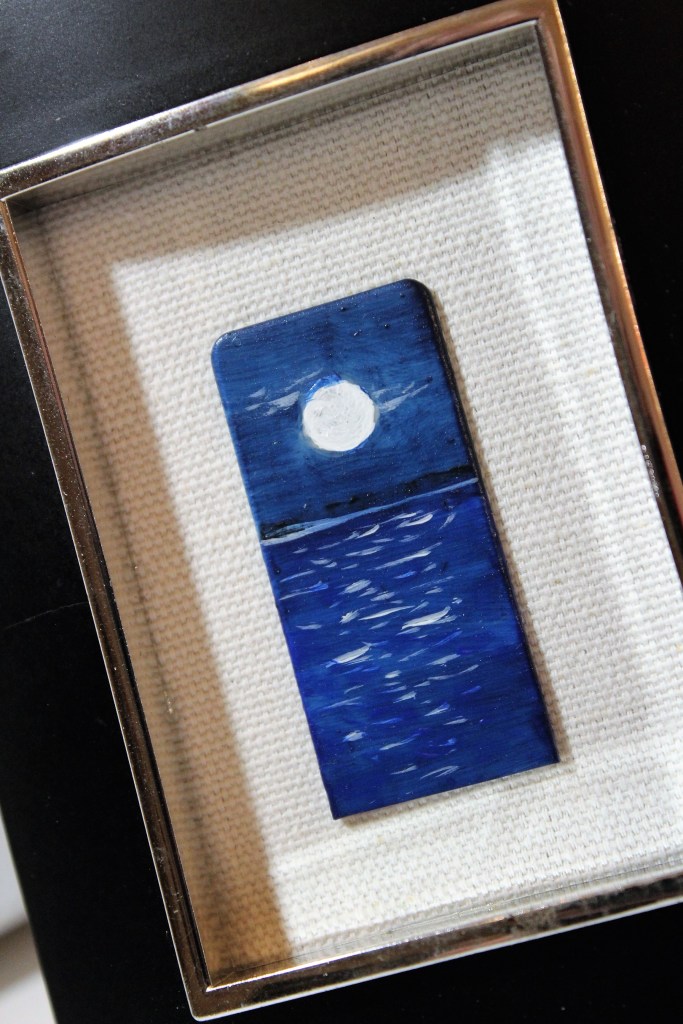

In addition to painting canvases and repurposing pianos, I also enjoy writing poetry. That said, I decided to write a short poem to go along with each painting. Three of them came out five lines long, which stands in perfect proportion to the keytop head. But for my favorite scene, the Blue Angels and Pensacola Lighthouse, I wanted something different. I had recently been to a show, and my mind was still filled with national pride in the skill and strength of our military. No, this one needed more than five lines of poetry! So instead, I wrote a shape poem in the form of a jet with its gray/white streaming contrail. Then with a bit of trial and error, I came up with a suitable display of both the poem and its accompanying miniature painting. To frame it, the Ocracoke design by Better Homes & Gardens, which looks like shiplap, was perfect. (Note, this style has apparently changed ownership. It’s now carried at Walmart under the Mainstays brand and in other stores under the name of Philip Whitney.) I also added a flourish of shells collected off the Pensacola Beach.


With the exception of “Angels and Light,” my original designs that included poetry were framed as 5×7’s and mounted to either black velvet or unbleached canvas. I printed the poem onto cardstock and layered scrapbooking papers underneath. There was a flaw in this design, however. By taking these items to craft fairs, I learned that they don’t hold up well under the Florida humidity. I tried several different adhesives, and the only one that worked was fabric glue, which is messy to work with. But I’m constantly watching YouTube videos to see how other crafters work, and I’ve learned a new technique that will greatly improve my design. I look forward to implementing the new ideas in the coming weeks and months. And of course, I’ll share them here when they’re finished.
To date my skipped-over scene ideas remain unused. One of these days I’ll get to them.
But I have painted other settings on ivory keytop heads by commission. My favorite was a recent commission for which I painted a Denver skyline. This was my first mini painting done in landscape mode. It kind of scared me, to be honest, because I had to make it recognizable as the city of Denver, not just a random city with a backdrop of mountains. Evidently I did well, for my customer was pleased. I’m always happy to oblige, and I’m honored whenever anyone asks for a custom piece.

Only a few of my original Ivory Illustrations remain: two small “Black River, White Sand,” and three large “Angels and Light.” As I paint more—and update the ones that include poetry—I’ll also add these to my shop.
If you have an idea for something you’d like special, by all means, let me know. After all, it was a suggestion from a friend that brought Ivory Illustrations to light in the first place!
Thank you for joining me on this tour of the studio. I look forward to seeing you on the next one. Until then, I invite you to check out photos of my other work in the gallery. Enjoy the rest of your day!
Welcome back to my piano art studio! Today I have a series of questions for you—their answers too, of course.
What’s your preference? As for me, I believe random is beautiful in certain situations, but my inclination is toward patterns. “A place for everything, and everything in its place,” right? This is why patterns appear in so many of the things I create from piano pieces. There is order in nature, there is order in music, and there is order inside a piano. Why not create more order from the pieces I find there?
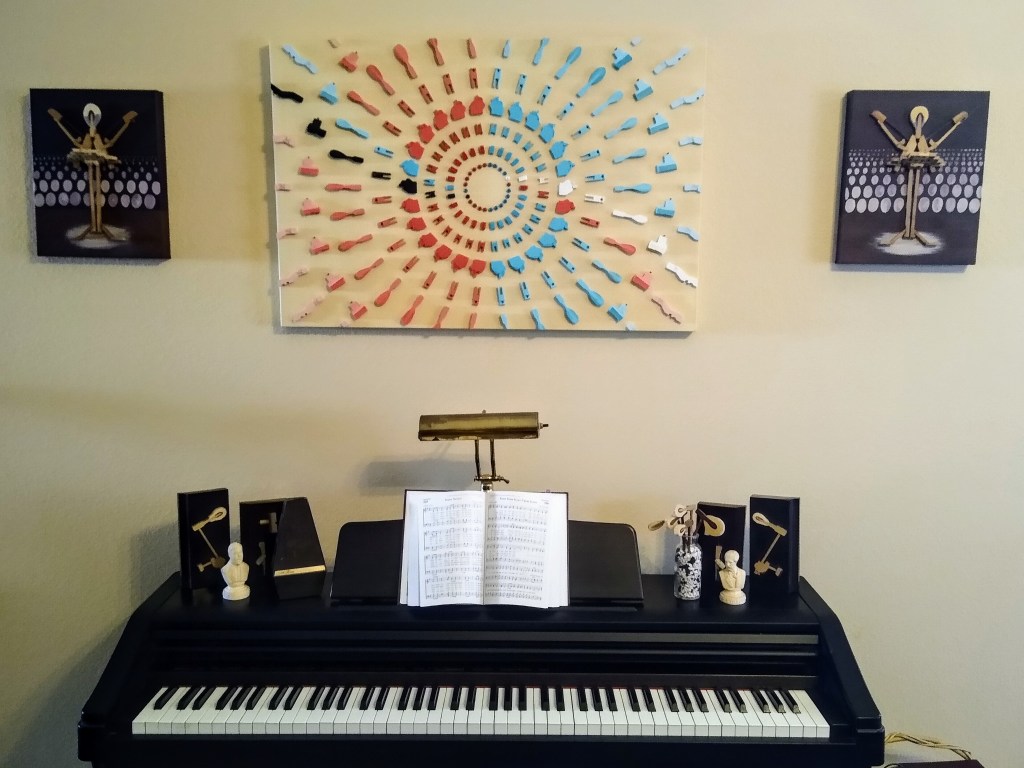
Measuring at 24 x 36 inches, “Riff” is the largest canvas piece I’ve created to date.


To begin with, I selected a variety of piano action pieces from among those I had previously cleaned, separated, and sorted. Then sitting on the living room floor, I arranged them in a three-foot circle. When I was satisfied with the arrangement, I placed them onto a 24×30 piece of plywood. I considered mounting them to the plywood, but changed my mind and went with the canvas instead.
Since the finished product would be rectangular rather than circular, I removed all the pieces that appeared beyond the boundary, leaving me with 196 pieces. The ones that lay along the edge were cut and sanded, to give the illusion of a continuous circle without having to show it in its entirety. I painted the gallery-wrapped canvas in a nice neutral tone, and also hand-painted every action piece. When the paint was dry, I glued the pieces down. To finish the piece, on the back I installed two sets of picture wire and D-hooks—one to use for vertical hanging, and another for a horizontal display. It truly looks good either way.


The circle was divided in half, representing the two parts of a standard musical staff: treble and bass. To color the pieces, I used vermillion on side and turquoise on the other. The parts in the center of the circle bear the darkest hues of each respective color, and the “ripples” which extend from the center grow increasingly lighter in hue. Additionally, I created a wavy line of white running through one side and another of black on the opposite side, representing the ivory and ebony of the keys. These were accompanied by one piece each from the other side, to represent the harmony created by playing the notes together.
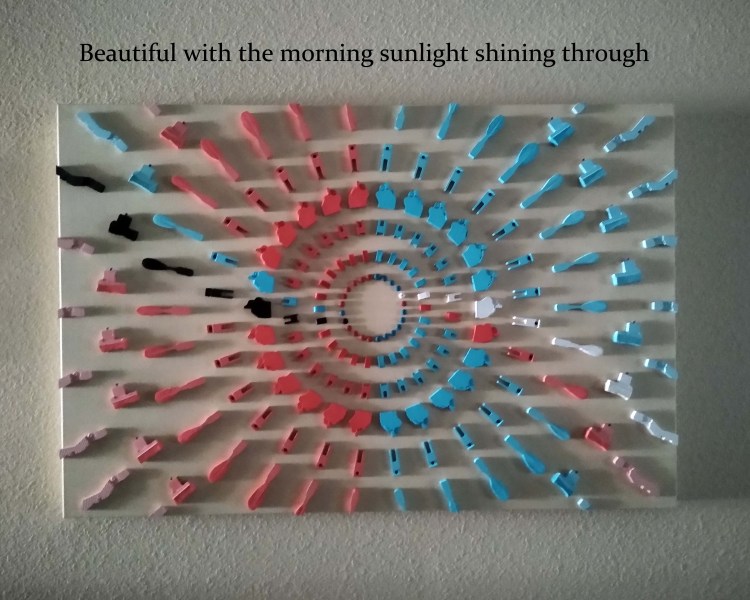
This one was dubbed “Riff,” a term I came across while learning to play guitar. A riff is a repeated chord progression or refrain; a pattern of sound that forms the foundation for the composition. This piece is a pattern in the form of a circle, so the name fits, don’t you think?
“Riff” is currently available for sale. If you’re interested in learning more, simply click here.
Thank you for joining me on this tour of the studio. I look forward to seeing you on the next one. Until then, I invite you to check out photos of my other work in the gallery. Enjoy the rest of your day!



 Encore! Old Pianos with a New Song