

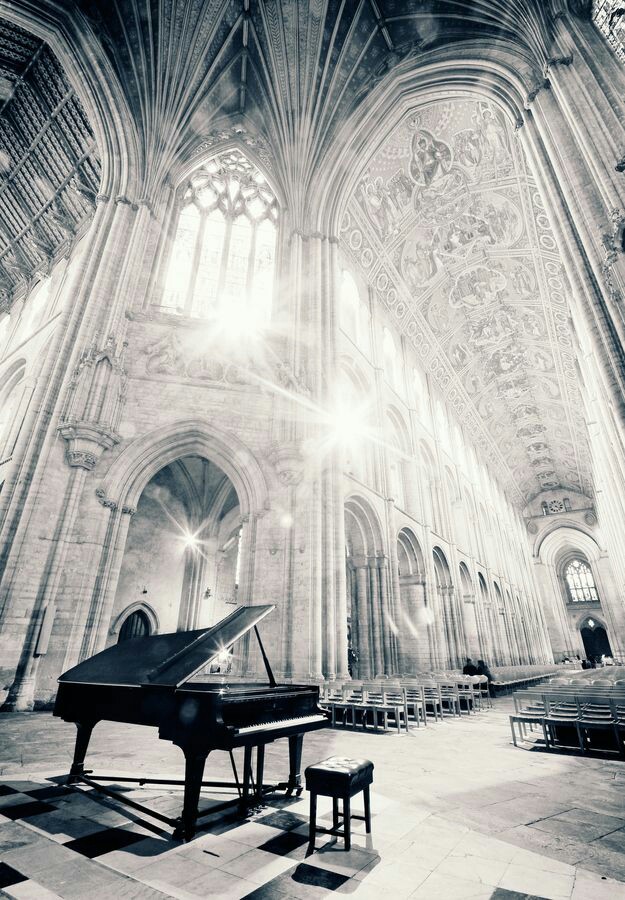
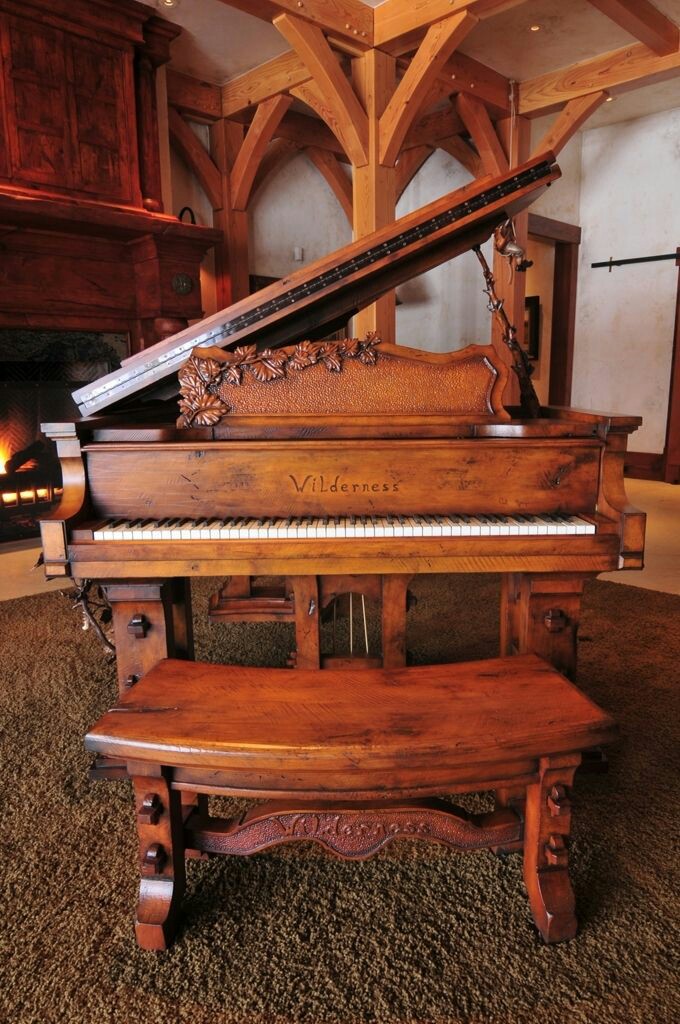
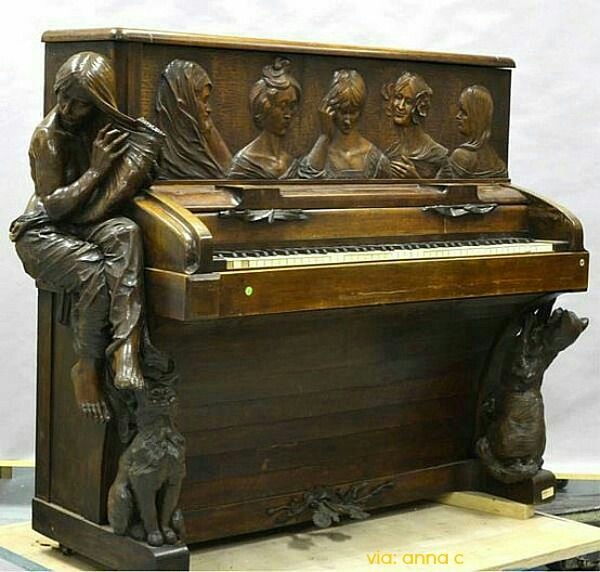
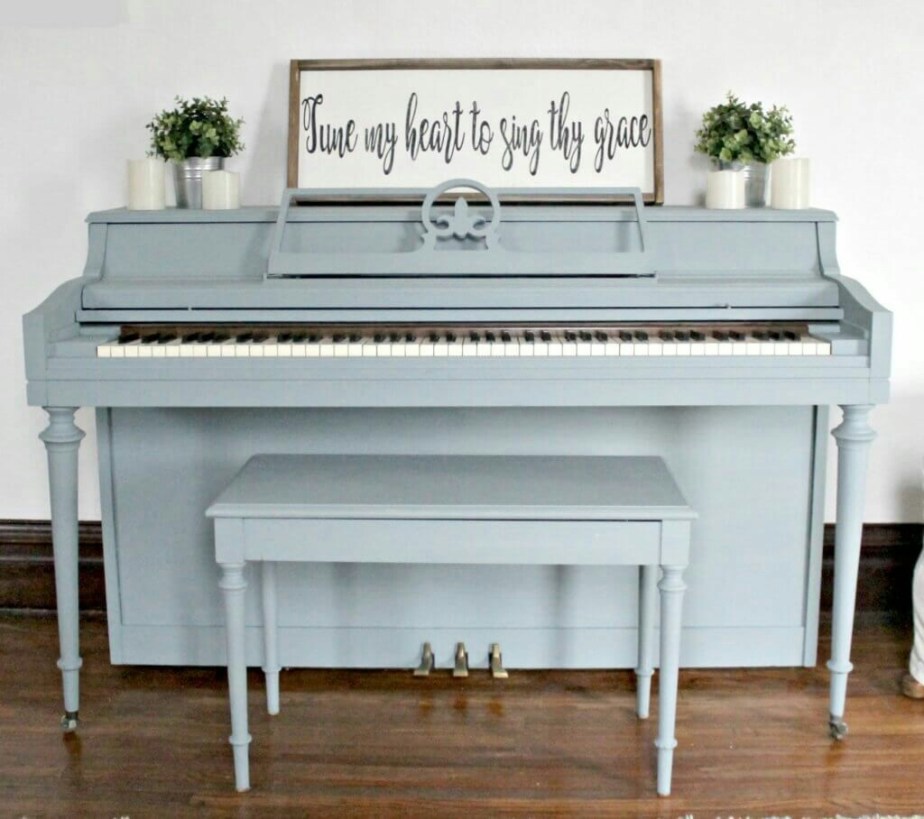
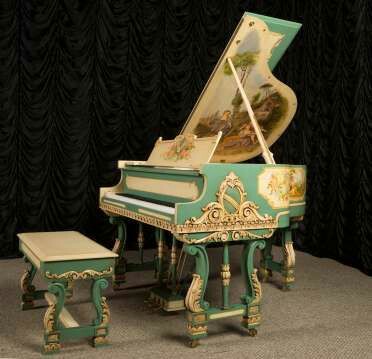
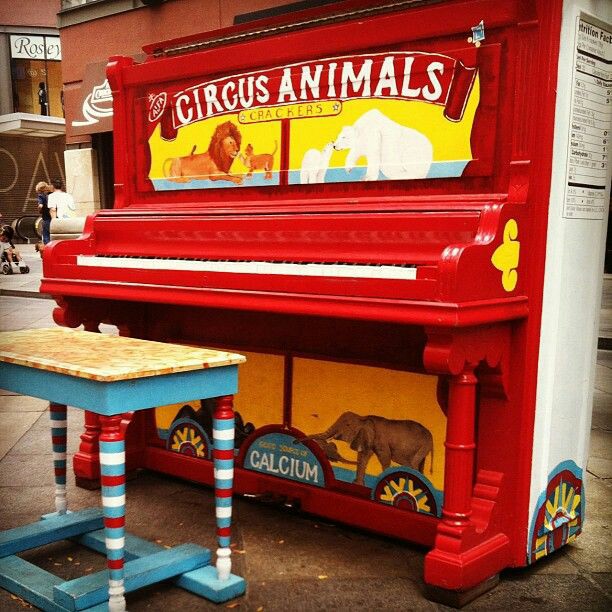
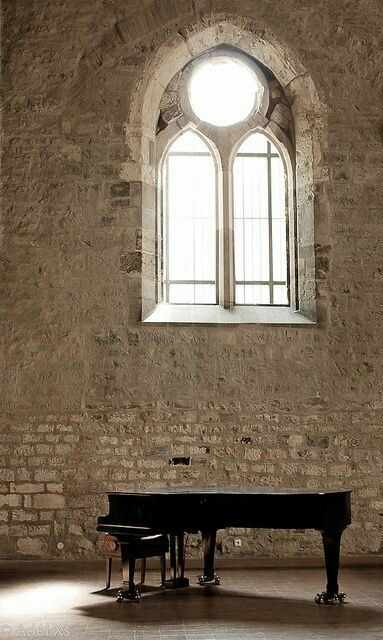
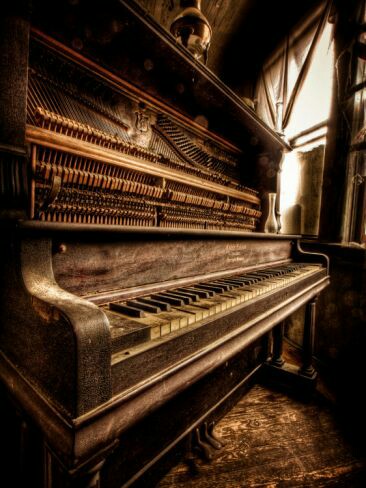
Here is a collection of stunning photographs of some of the most unusual pianos you have ever seen.
Month: March 2019














From the Studio: Bach Yard Chickens
Raising backyard chickens has really taken wing in the US. Sorry. Was that a bad pun? Okay. I’ll stick to piano art and leave the comedy for the comedians. 😉
But I wasn’t trying to jump on the bandwagon when I created “Bach Yard Chickens.” I simply saw the hammer butts and thought they looked like chickens. Period. End of story. The little girl, as hard as she was for me to paint, seemed a little easier than painting a barn. Not only that, but for each of my creations, I try to come up with a music-themed title. So… “Bach Yard Chickens” or “Old MacDonald”? Which one would you have chosen? I thought so. Me too!

The painting above was my first ever “Bach Yard Chickens,” completed in 2015. It was done on a 16×20 stretched canvas, unframed. I used uncooked quinoa for the “seed,” and all five “chickens” came from the same piano. In fact, they came from the 1906 Lyon & Healy, my first piano. (At the time, it was my only piano.)
Spreading My Wings
I had been really nervous about creating this particular piece because I had never painted a person before. I was working off a photograph, and the girl didn’t turn out exactly like the image in the photo. But I figured it was okay; she was good enough. And I guess she was, for this painting was the first item to sell in the craft fair that year, which was very encouraging to me. In fact, it sold within fifteen minutes of the show’s opening.
So why did it take me another four years to work up enough courage to make Bach Yard Chickens #2? I honestly couldn’t tell you. But the second one is done, and it’s pictured here.

This one has some obvious differences. One variation you may not notice in the photos is the size, for this one is an 11×14. I decided to try a smaller size because the piano parts themselves are so small by comparison to the canvas. I also have two more 11×14 paintings nearly finished. However, I do prefer the larger size, and will make the future paintings in the original 16×20 format.
Another difference is that the “chickens” now come from different upright pianos, to represent the reality that in a brood of backyard chickens, they will not all look exactly alike.
The Process

Here are some representatives of the hammers I’ve taken off the pianos. When I remove them, they are dirty. I have to scrub them clean with a wire brush, then separate the various parts. Each individual piece has a name, but for the sake of simplicity, I’ll call the entire “chicken” part the hammer butt. It has a flange attached at the chicken’s “eye,” made of either wood or metal. I have a special tool that helps me to quickly and safely remove the flange, which I save for later use in another project.
You may also notice a string coming off some of the chickens. That’s called the bridle strap. Sometimes I can pull it off, but other times I have to cut it off with a box cutter.
For the next step, I take the hammer to the garage, where my power tools are set up. One of my table saws is equipped with jig saw blades. I use this one to remove the hammer shank (long stick) from the hammer (where the felt is) and hammer butt (a.k.a. chicken). The hammer shank goes into a storage container for some future use which I haven’t figured out yet. The hammer is set aside to be used as a key chain or as a head for a Conductor or Instrumentalist.
Finally, with a little sanding, the butt is ready to be used as a chicken. This process takes about 45 minutes to an hour for 5 chickens, not counting the time it takes to remove the hammer from the piano. That stage can vary greatly, I’ve come to learn, depending on the manufacture of the piano. The new flange removal tool has shortened the time by a good 15 minutes. Before I got that tool, I used any sharp tool I could find, such as an ice pick, to push the pin partway through, then I would pull out the rest of the way with pliers. This was tedious and made my hands hurt after a while. I’m very thankful for the new tool!
Art for Arts’ Sake
One of my favorite things about Bach Yard Chickens is getting to paint the background. I love what I do with old pianos, but above all, I love that God gave me the ability to paint. I don’t have much training in that area, but I do long to develop what talent is there by practicing. I want my work to be more than a craft—I want it to be an art.
Thank you for joining me on this tour of the studio. I look forward to seeing you on the next one. Until then, I invite you to check out photos of my other work in the gallery. Enjoy the rest of your day!
Lens-Artists Photo Challenge #38: Weathered and Worn
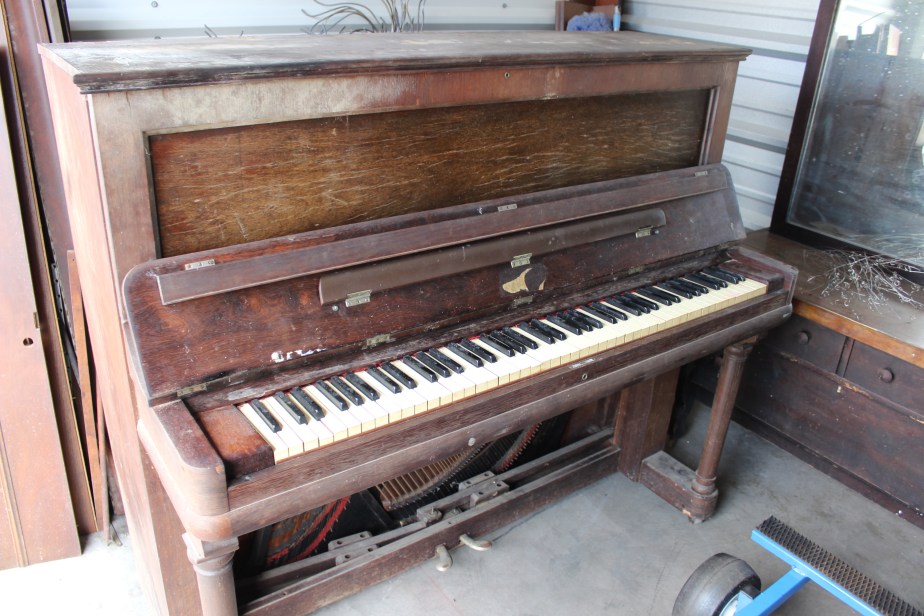
This week’s challenge was easy, as nearly every piano I’ve ever brought into the family has fit the description of “weathered and worn.”

While I love my mission of helping old pianos sing a new song, sometimes it can be quite a challenge due to the conditions from which they have been rescued. People “retire” their pianos to the garage or to a non-climate-controlled storage unit when they no longer have a use for them. Sometimes they move out of the family home, or pass away, and the piano, too heavy to move, is abandoned in the home. If the home sits vacant for any length of time, then both weather and critters take their toll on this once beautiful and fine instrument. It doesn’t matter how much time and effort was put into creating a piano. The highest quality piano ever produced is humbled to the level of the most affordable instrument fashioned for the humblest of homes when it is neglected for decades on end. But even these have a certain charm, you’ll have to admit.

This week I am responding to the Lens-Artists Photo Challenge #38 — Weathered or Worn, hosted by Ann-Christine a.k.a Leya of lagottocattleya.wordpress.com. I found this challenge on Cee Neuner’s website.
Thanks, Cee, for this wonderful directory you’ve created: “For the Love of Challenges.” For the record, Cee’s directory lists not only photo challenges, but also writing and music challenges as well, and they are grouped by category. It’s very well organized.
Polaroids of Light and Sound / The Piano Sketches E.P. — JamesRadcliffe.com

I purchased his album and have already listened to the first track. It’s time to go move a couple pianos into my new, larger workshop. But when I return, I look forward to enjoying the rest.
Won’t you join me in sponsoring this fellow artist by reading and responding to his post, following him, purchasing his new album, or all of the above.
It is one of life’s ironies that, if you want freedom, you have to impose limits. Nowhere is this truer for me than in my work. Unlimited options often lead to paralysis, whereas the right limits, artfully imposed, allow creativity to flourish. It was with this in mind that, at the end of November last […]
via Polaroids of Light and Sound / The Piano Sketches E.P. — JamesRadcliffe.com

Kohler & Campbell: King of the Industry

A Perfect Match
Charles Kohler was only twenty years old in 1894, when he and John Calvin Campbell united forces to establish Kohler & Campbell Industries, Inc., in New York City. Though a young man, Kohler was considered a genius as a businessman and factory superintendent. His partner, J. C. Campbell, was a machinist skilled in working with both wood and iron, and he used these skills to improve the manufacturing of pianos and earn Kohler & Campbell their reputation for offering “the best value for the dollar.” These two men were a perfect match in business, and their company grew to become one of the all-time giants in the piano manufacturing industry.
Bought and Sold
Campbell died unexpectedly in 1908, and Charles Kohler took control of the company. The business continued to expand, as they absorbed less successful names, such as Autopiano (ca. 1920), Waldorf (mid-1920s), Behning (1926), and Newton (ca. 1930). During the pre-Depression era, the Standard Pneumatic Action Company, a subsidiary of Kohler & Campbell, manufactured an impressive 50,000 player piano actions, and more, per year. Kohler & Campbell grands were made by Brambach in Granite Falls, NC, and in 1954, all production was moved to Granite Falls.
For 100 years the company thrived in the United States as a supplier to major retailers across the country. However, they hit hard times in 1985 and suspended manufacturing. After negotiations, Sherman Clay bought the Kohler & Campbell name and contracted Samick USA to build Kohler grand pianos for retail stores. Later, Samick USA bought the name from Sherman Clay and expanded distribution to South Korea.
Kohler pianos are still being produced today, and the line has now been expanded to include digital pianos in both baby grand and upright cabinet styles. Once the king of the industry, Kohler is still a major presence. If you own a Kohler piano, or a Kohler & Campbell, you may be proud of its amazing history.
The One I Acquired


The Kohler & Campbell piano that was given to me was an upright grand, serial number 163634, which dates to 1902, meaning this piano was built when the company was only eight years old, and it was 113 years old when it joined the Encore! family. Unfortunately, it suffered much water damage while in storage, but I was able to use the keys and the action. I still have many pieces of the case, but have not tried to restore them. Soon I will.
A friend and fellow choir member gave me the piano, so I thought it would be appropriate to use pieces from this piano to make Christmas gifts for the choir members. And that’s exactly what I did. The choir director got a Conductor made of whippen and sticker assemblies (technically not from this piano), and each choir member received an ornament for their Christmas tree. They were able to choose from a hammer ornament or a diamond-shaped ornament cut from the soundboard. This piano had a most unusual action piece that I had never seen anywhere else. It was shaped like a bell (see photos), and I used it to decorate a second set of soundboard ornaments which we gave to the members of my daughter’s handbell choir.
All the ornaments were personalized on the back with the year and the name of the choir. I still love pulling mine out each year and hanging it on the tree, even though we’ve since moved to another state and sing in another choir. When I look at that ornament, I’m reminded of the friends whose voices used to blend with mine in praise to God. I see their faces, and I smile. That, my friends, is why I make art from these old pianos.
Bibliography
Pierce, W. Robert. Pierce Piano Atlas. 12th Edition. Larry E. Ashley Publishing: Albuquerque, NM, 2008

Flash Fiction: Wood Piano
What a beautiful old piano! And what a charming little story! Do take a minute to read this….

It lay untouched by the entrance.
The eccentric restaurateur had purchased the wooden piano from the antique shop. He thought that it ornamentally fit in with his restaurant, The Musical Meal. After placing it by the entrance, he did not give it a second thought. He did not look at it until a few months later, when he heard a commotion outside the restaurant. He rushed outside to find a small crowd gathered. The people were all clapping and cheering for a ragged looking old man sitting at the wood piano, playing it.
As he played, flowers bloomed on it…
Word Count: 100
Prompt:

Lyon & Healy Didn’t Just Make Pianos
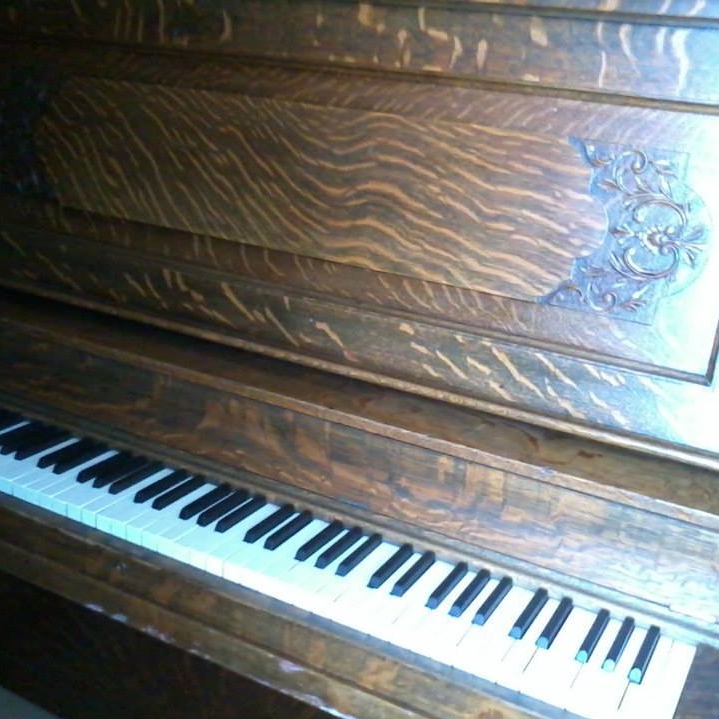
The piano that started me on my art journey was a Lyon & Healy upright grand, built in 1906. In addition to studying the parts themselves to figure out what I could do with them, I also wanted to learn all I could about who made this fine musical instrument. While I do not claim to know enough to even call myself an amateur, I will gladly share with you the snippets I have learned.
George W. Lyon and Patrick J. Healy came from Boston to Chicago in 1864 to open a store selling sheet music. Their venture proved to be extremely successful, and within a year they expanded the business and began carrying musical instruments as well. They survived the Great Fire of 1871 because they had excellent insurance coverage. While rebuilding, they acquired the piano business of another firm and became the sole representative in the Chicago area of Steinway & Sons. This was the start of a meaningful relationship with the piano icons from Germany.
Harping on Excellence
Healy noticed that his repair shops were filled with harps that needed a great deal of work, so he set about to design “the finest harp the world has ever seen.” It took years of research, but in 1889, the first Lyon & Healy harp was produced, and it was played daily at Morgan Park High School in Chicago for 90 years, until it was returned to the company to be put on display in the Museo Dell’Arpa Victor Salvi in Italy. Healy’s hard work paid off, and his company became known as the world’s leading manufacturer for concert harps.
In the late 1800s Lyon and Healy further expanded their business. They were already carrying pianos made by other manufacturers, but now they began to produce their own: uprights, players, and grands. They also produced a line of upright pianos under the name of “Washburn” as an affordable alternative to the more elite Lyon & Healy brand.
Pianos and harps were not the only instruments produced by Lyon & Healy. For a while they also built pipe organs for both home and church use, as well as a variety of brass and woodwind instruments. And they did not forget their humble beginnings, for by 1930 they were the largest distributor of sheet music. In fact, they were advertised as being “the world’s largest music house.” New upright pianos sold at that time for $125 to $290. Bear in mind that the average house sold for $4,700, you could buy a car for $1,450, and a loaf of bread cost 4 cents. Many professionals had an annual salary of $1,500 to $4,000.
The Great Pruning
During the Great Depression, the Everett Piano Company bought Lyon & Healy’s piano division, but they continued making pianos under the Lyon & Healy brand until the 1970s, when Steinway & Sons purchased all rights to the name. Steinway closed all Lyon & Healy retail stores and discontinued production of all instruments and sheet music so that the company could focus on the production of harps. It sounds harsh, but sometimes a farmer has to prune branches that are producing fruit so that the remaining branches will produce more and better fruit. After this pruning, Lyon & Healy regained their focus, and their harp industry continues to this day. If not for the hard decision that Steinway made back in the 1970s, Lyon & Healy may well have closed their doors completely by now.
After reading about the humble beginnings, the amazing accomplishments, the harsh pruning, and the incredible longevity of this great company, I have even more respect for the makers of the fine instrument that started me down the path of creating piano art.
Does It Hurt?
At craft shows I have the pleasure of meeting and conversing with a good many folk who stop by my table. Often they ask, “Does it hurt you to take the pianos apart?” My answer has always been: “No. It’s my pleasure because I am keeping them out of the landfill; I’m giving them a new purpose.” But today, after researching to write this article, I must admit that my heart is pained some—okay, more than a little—for this piano in particular. If I had known its history before we started to take it apart, I would have found the $5,000, or whatever it would have taken, to restore it. Because this one would have been worth the cost. And yes, I’m writing this through tears. It’s just a bunch of wood and metal, you say. But that hunk of wood and metal was assembled by a master craftsman, better than most of the others I’ve come across. I can only hope that the people who have purchased items made from the gorgeous tiger oak cabinet and all the action pieces within will appreciate the love that went into creating the piano in the first place, and then the love that went into creating the art.
Here are a few photos of my 1906 Lyon & Healy, as well as some of the works of art I made from it:
Bibliography
Pierce, W. Robert. Pierce Piano Atlas. 12th Edition. Larry E. Ashley Publishing: Albuquerque, NM, 2008
Riverwalk Arts Festival Update
I promised you an update on the arts festival from this past weekend. In a word, it was tremendous! My daughter and I picked up my packet Friday afternoon, and we set up the tent and tables that evening. Due to the inclement weather, and the sensitivity of the piano parts to humidity (especially the felt), I decided not to set out my merchandise until Saturday morning. We also helped one of our neighbors with her tent, as it was similar to ours and new to her. One of the joys of doing shows is getting to meet the neighbors.
My daughter had things to do on campus, so I took her back Friday night and went alone to the festival early Saturday morning to set up. I had made a good call, for it rained during the night. Nothing was wet except the ground, and everything was off the ground. So I pushed the puddled water off the roof of my tent, opened up the walls, and got everything in its place just in time, about fifteen minutes before time for judging.
When the judge came by, she blended herself in with the crowd, and I never knew she was there. So when she and another lady stopped by my table in the early afternoon with a blue ribbon, I was completely astounded and elated. This was my first juried event, so needless to say, I was on Cloud Nine.
I had been wondering whether or not to stay for Sunday. The Lord held off the rain for most of Saturday, with the exception of just a light sprinkle, but Sunday we were expecting a downpour. Not only that, but my family would be in church and unavailable to help me take things down. So I prayed for a particular amount in sales on Saturday as a guide to whether I should return, and the Lord gave me those sales. My husband came after work Saturday and helped me break down my tent. I had been busy helping my neighbor break hers down, so I wasn’t ready when he got there, but he was very patient with me. We went out to eat afterwards, rejoicing in the Lord and in the good day.
As it turns out, the storm did not come until after 2 p.m. Sunday, but it’s just as well that we packed up when we did. I attended the awards breakfast Sunday morning and got to meet our mayor and a few more fellow artists, including another artist who has some of her work in a gift shop in Navarre, the Sand Dollar Cottage. I’ve seen her work there and admired it, so it was a pleasure to meet her. At the breakfast, the spokeswoman said that in 31 years of hosting the Riverwalk Arts Festival, this is only the second time they’ve had rain. That’s a pretty good track record. Will I be back next year? You bet!
Weekly Photo Challenge: Dogs of Blogs
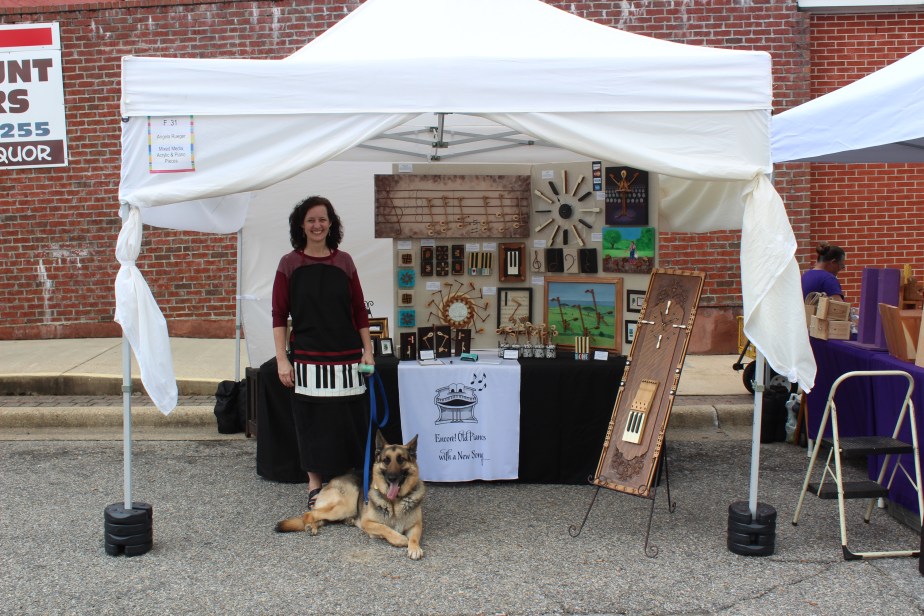
Duke, a 6-year-old German shepherd, is a relatively new addition to our family. My son adopted him a year ago in Virginia, and he just came to live with us last month. When Bobby found him, Duke was malnourished, sick, and severely underweight. With the help of a family friend, who also happens to be a veterinarian assistant, Duke got the care he needed, and now he is healthy and happy.
Duke loves to shadow me around the house. I don’t allow him in the studio because there isn’t enough room in there for the two of us, but he is right by my side in the living room and kitchen.
Duke did not go with me to the art show, but Bobby stopped by for a visit, and I asked him to take a photo of my display, with me in it. Naturally, I had to hold Duke so Bobby could hold the camera.
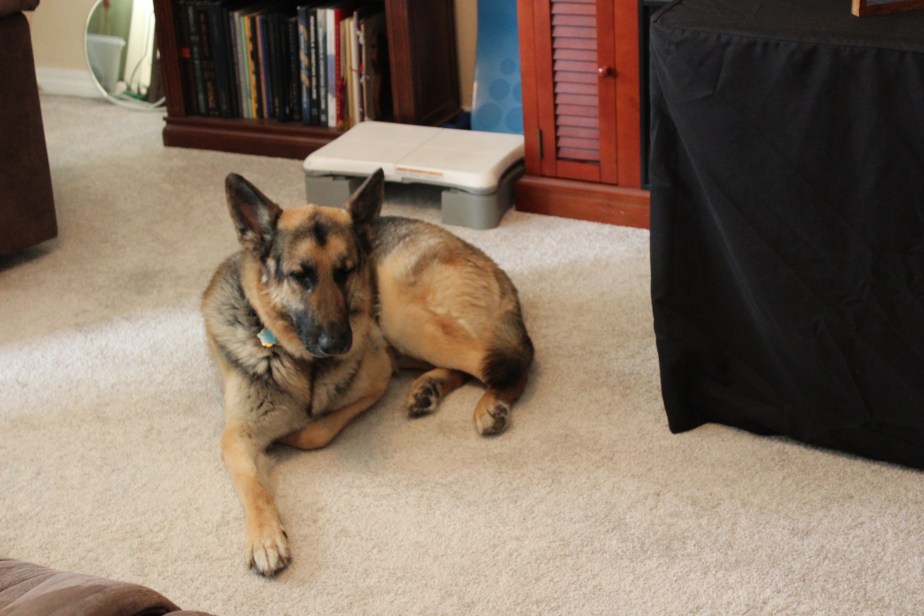
This week I am responding to the photo challenge, Dogs of Blogs, hosted by Jessica of Sorting Life’s Issues with Jess. She has chosen a dog theme for the month of March to celebrate the birthday of her dog Oreo. I do hope you’ll hop over to her page and take a look. Her photos are absolutely adorable.
I discovered Jessica, her blog, and her challenge, on Cee Neuner’s list of challenges, so I wish to give her credit as well. Thanks, Cee, for this wonderful directory you’ve created: “For the Love of Challenges.” For the record, Cee’s directory lists not only photo challenges, but also writing and music challenges as well, and they are grouped by category. It’s very well organized.

Tomorrow I’ll give you more details about the show.
Feeling Devastated, or, What My Piano Teacher Means to Me — The Bookshelf of Emily J.

It has been a rough week at my house, for several reasons, many of which I won’t write about. But yesterday a lot of emotions overflowed when I received a letter from my piano teacher, Kris Davis, the one who guided me through my adolescent years. More accurately, I received a letter from her husband. […]
via Feeling Devastated, or, What My Piano Teacher Means to Me — The Bookshelf of Emily J.
The Bible instructs us to rejoice with those who rejoice and weep with those who weep. This story caused me to do both. I wept for the grief that Emily, her teacher, and their families are going through, but I rejoiced in what God is doing in Emily’s life. What a vibrant testimony this young lady has for our Lord! And I am honored to share her story with you.
 Encore! Old Pianos with a New Song