A Brief Reign for the Royal Piano Company


The Royal Piano Company did not exist a long time, and information regarding their organization and operation is hard to find. But in their short span on the industrial scene, they produced some of the finest musical instruments America has ever seen. Royal was established around 1895 and manufactured fine quality pianos for about half a century, producing a full line of uprights, player pianos, and baby grands. They also built pump organs in the early years of the company’s existence.

Royal was originally a division of the Krell Piano Company, and it was bought out by Werner Industries of Cincinnati shortly before 1920. The Starr Piano Company purchased the Royal brand in 1927, and thus kept the Royal name alive during the Great Depression.

The last Royal piano was built in 1949. Today they are rare, but if you happen upon one, you will find it to be an example of quality workmanship.

The One I Acquired
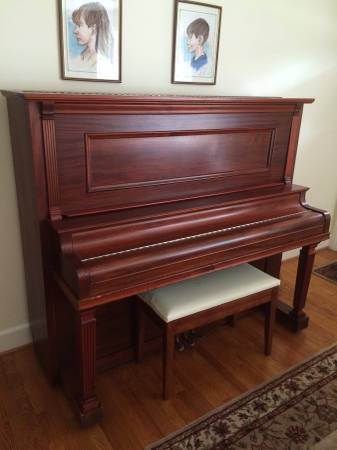
Royal Cabinet Grand (1)

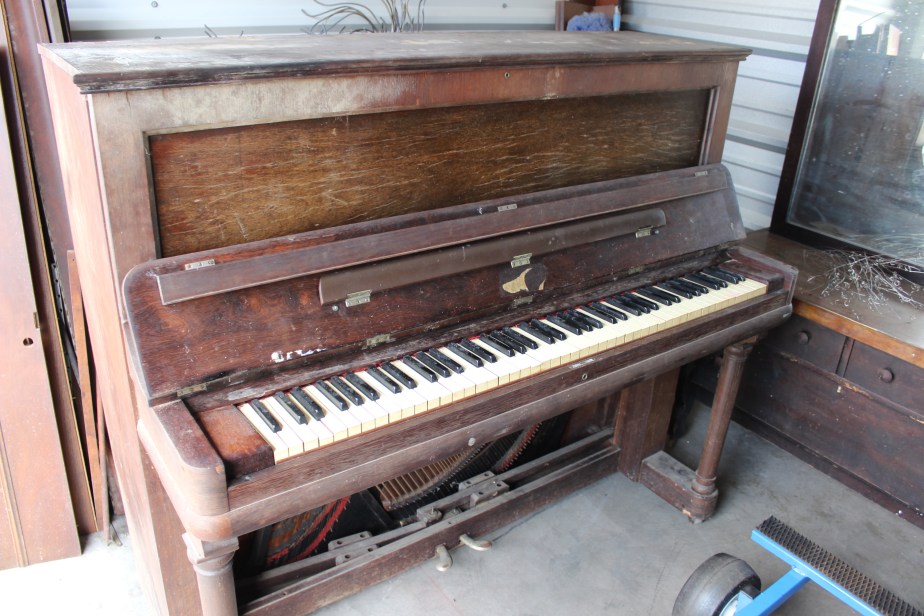
The Royal Cabinet Grand that came into my possession was not a gift, but was actually the only piano to date for which I have put down money (apart from moving expenses). I had been commissioned to make a headboard for a retired piano teacher who was confined to a hospital bed in her room. The former teacher’s daughter saw a coat rack that I had made from the music shelf of the Lyon & Healy, and she thought a headboard would be perfect for her mother, who had devoted her life to teaching others how to play the piano. How could I say no? I had several large pieces at hand, but none worthy of such an assignment. So I searched eBay, Craigslist, and other local listings until I found the perfect piano. It wasn’t free, but it was affordable.

Since I purchased the piano with a particular project in mind—the headboard, the majority of my photos of this piano are focused on the music shelf. Evidently, I didn’t even think to take a photo of the serial number, which is something I ordinarily do with every piano. Or if I did, I didn’t file the photo correctly. Unfortunately, that number is long gone by now, so I’ll never be able to determine exactly when this piano was made.

But there is a silver lining, for maybe someday, in a bin in the garage, I’ll find the cast iron plate that bears the Royal name. For I noticed in one of the photos that I removed the plate before letting Bobby haul the frame to the scrap yard. And in my search for information about the Royal Piano Company, I found a similar plate on a estate sale website that sold for over $200. Wouldn’t that be nice…. ☺

It has been noted that Royal pianos are known for their fine craftsmanship. I can definitely attest to this. At this point, I don’t remember which hammers, whippens, or stickers in my bins came out of the Royal Cabinet Grand, but I do remember the wood case, that it was both beautiful and solid. When we were preparing to move, some of my pieces got rained on, and I was horrified to learn (when the pieces swelled) that two of the pianos were partially built with press board! I was shocked! Most of them were not, however, and the Royal is most certainly made of solid wood. I don’t know for sure what kind of wood it is, but it is a hardwood. My saw and drill can attest to that (and my tired arm). Yet the most impressive thing to me—especially after taking apart thirteen pianos thus far—is not the fact that the cabinet is solid, or that it is made of hardwood, but the thickness of the wood, especially on the sides of the cabinet. On every piano, the side arm (the part that often resembles a grand piano in its shape) is nearly two inches thick, but the side board (the board that covers the length of the piano) is usually less than one inch thick, though it may have some trim along the edge to give the appearance of extra thickness. On the Royal Cabinet Grand, the entire side board was as thick as the side arm—just under two inches. And the cabinet’s finish was a gorgeous red mahogany.


The wood of the side board was too thick to use in large pieces, but too nice not to use at all. So I cut the wood into blocks measuring 6″ x 7.5″ and made game boards out of them, using tuning pins as the playing pieces. The concept was fairly easy to devise, but the implementation turned out to be difficult with hand tools. I made five games last year. They were imperfect at best, but my husband was impressed enough to purchase a drill press and power sander for me so that my next batch of board games will come out a lot nicer. Isn’t he sweet! Royal Cabinet Grand (1)
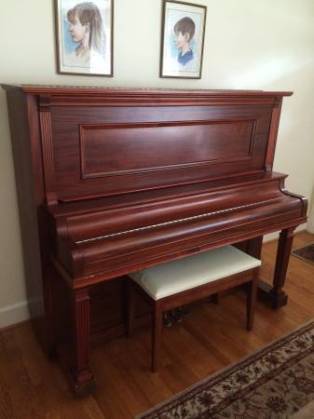
Of the thirteen pianos I’ve disassembled so far, the Royal Cabinet Grand is the only one to give me good quality wood that I can use to make these board games. Hopefully I’ll come across more pianos built with this level of quality in the near future.

If you happen to have a Royal piano, by all means keep it and treasure it. Tune it. Play it. Enjoy it. Pass it down to your children and their children after them. Don’t let it go the Piano Lady to be cut up and made into headboards, games, and art—not unless it absolutely must be thrown away. In that case, do call me first (if you live within 200 miles of Pensacola, FL). But please know that I no longer purchase pianos. I will, however, thank you for your donation by making you a souvenir piece of art from your piano.


Bibliography

Pierce, W. Robert. Pierce Piano Atlas. 12th Edition. Larry E. Ashley Publishing: Albuquerque, NM, 2008

antiquepianoshop.com

coolpianostuff.com

sweeneypiano.com

The Premier Estate Sale Marketplace


Weekly Photo Challenge: Vertical

What I like most about things vertical is that they remind me to look up.

Luke 21:28b  Look up, and lift up your heads, for your redemption draws near.

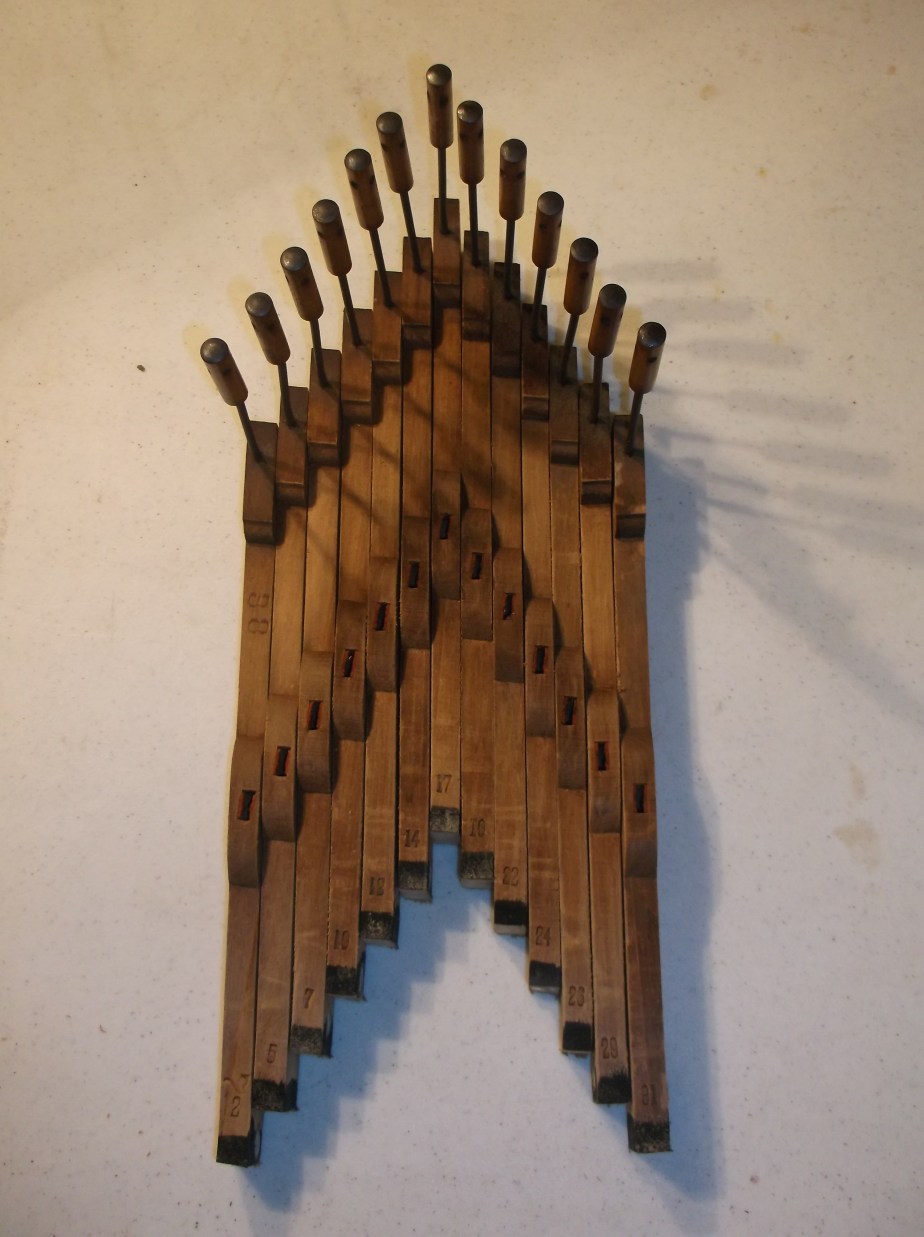
piano key extensions in an arrow formation
Fermata

This week’s challenge is hosted by Travel with Intent, and the theme is VERTICAL. This is another no-brainer in the realm of old pianos, as an alternate way to describe upright pianos is to call them verticals.

However, since I’ve used a good many photos of my pianos already, I decided this week to show other examples of “vertical,” such as the arrangement of key extensions above. It’s been given a name, “Fermata,” although it only slightly bears a resemblance to the musical symbol. The only trouble with this piece is that it has yet to be finished. It’s only in the planning stage. Maybe someday…. One day I arranged the pieces on the table and took a picture of them, trying to decide if I actually wanted to create a work with this design. What do you think? Feel free to leave your comments or suggestions below.

This next photo is my piano moving team: Matthew, Bobby, and Dolly. Dolly does most of the heavy lifting, but she and I couldn’t do anything without Matthew and Bobby.

two young men standing on a piano dolly
workers at play

Thanks again to Cee Neuner for her amazing directory, “For the Love of Challenges.” For the record, Cee’s directory lists not only photo challenges, but also writing and music challenges as well, and they are grouped by category. It’s very well organized.


Lens-Artists Photo Challenge #38: Weathered and Worn

1866 Steinway (4)
1866 Steinway

This week’s challenge was easy, as nearly every piano I’ve ever brought into the family has fit the description of “weathered and worn.”

Hughes 03
1902 Kohler & Campbell

While I love my mission of helping old pianos sing a new song, sometimes it can be quite a challenge due to the conditions from which they have been rescued. People “retire” their pianos to the garage or to a non-climate-controlled storage unit when they no longer have a use for them. Sometimes they move out of the family home, or pass away, and the piano, too heavy to move, is abandoned in the home. If the home sits vacant for any length of time, then both weather and critters take their toll on this once beautiful and fine instrument. It doesn’t matter how much time and effort was put into creating a piano. The highest quality piano ever produced is humbled to the level of the most affordable instrument fashioned for the humblest of homes when it is neglected for decades on end. But even these have a certain charm, you’ll have to admit.

pedals (2)
1895 Chas. M. Stieff

This week I am responding to the Lens-Artists Photo Challenge #38 — Weathered or Worn, hosted by Ann-Christine a.k.a Leya of lagottocattleya.wordpress.com. I found this challenge on Cee Neuner’s website

Thanks, Cee, for this wonderful directory you’ve created: “For the Love of Challenges.” For the record, Cee’s directory lists not only photo challenges, but also writing and music challenges as well, and they are grouped by category. It’s very well organized.


Kohler & Campbell: King of the Industry

Hughes 01

A Perfect Match

Charles Kohler was only twenty years old in 1894, when he and John Calvin Campbell united forces to establish Kohler & Campbell Industries, Inc., in New York City. Though a young man, Kohler was considered a genius as a businessman and factory superintendent. His partner, J. C. Campbell, was a machinist skilled in working with both wood and iron, and he used these skills to improve the manufacturing of pianos and earn Kohler & Campbell their reputation for offering “the best value for the dollar.” These two men were a perfect match in business, and their company grew to become one of the all-time giants in the piano manufacturing industry.

Bought and Sold

Campbell died unexpectedly in 1908, and Charles Kohler took control of the company. The business continued to expand, as they absorbed less successful names, such as Autopiano (ca. 1920), Waldorf (mid-1920s), Behning (1926), and Newton (ca. 1930). During the pre-Depression era, the Standard Pneumatic Action Company, a subsidiary of Kohler & Campbell, manufactured an impressive 50,000 player piano actions, and more, per year. Kohler & Campbell grands were made by Brambach in Granite Falls, NC, and in 1954, all production was moved to Granite Falls.

For 100 years the company thrived in the United States as a supplier to major retailers across the country. However, they hit hard times in 1985 and suspended manufacturing. After negotiations, Sherman Clay bought the Kohler & Campbell name and contracted Samick USA to build Kohler grand pianos for retail stores. Later, Samick USA bought the name from Sherman Clay and expanded distribution to South Korea.

Kohler pianos are still being produced today, and the line has now been expanded to include digital pianos in both baby grand and upright cabinet styles. Once the king of the industry, Kohler is still a major presence. If you own a Kohler piano, or a Kohler & Campbell, you may be proud of its amazing history.

The One I Acquired

The Kohler & Campbell piano that was given to me was an upright grand, serial number 163634, which dates to 1902, meaning this piano was built when the company was only eight years old, and it was 113 years old when it joined the Encore! family. Unfortunately, it suffered much water damage while in storage, but I was able to use the keys and the action. I still have many pieces of the case, but have not tried to restore them. Soon I will.

A friend and fellow choir member gave me the piano, so I thought it would be appropriate to use pieces from this piano to make Christmas gifts for the choir members. And that’s exactly what I did. The choir director got a Conductor made of whippen and sticker assemblies (technically not from this piano), and each choir member received an ornament for their Christmas tree. They were able to choose from a hammer ornament or a diamond-shaped ornament cut from the soundboard. This piano had a most unusual action piece that I had never seen anywhere else. It was shaped like a bell (see photos), and I used it to decorate a second set of soundboard ornaments which we gave to the members of my daughter’s handbell choir.

All the ornaments were personalized on the back with the year and the name of the choir. I still love pulling mine out each year and hanging it on the tree, even though we’ve since moved to another state and sing in another choir. When I look at that ornament, I’m reminded of the friends whose voices used to blend with mine in praise to God. I see their faces, and I smile. That, my friends, is why I make art from these old pianos.

This slideshow requires JavaScript.


Bibliography

Pierce, W. Robert. Pierce Piano Atlas. 12th Edition. Larry E. Ashley Publishing: Albuquerque, NM, 2008

antiquepianoshop.com

kohleryandcampbell.com

kohlerdigitalpianos.com